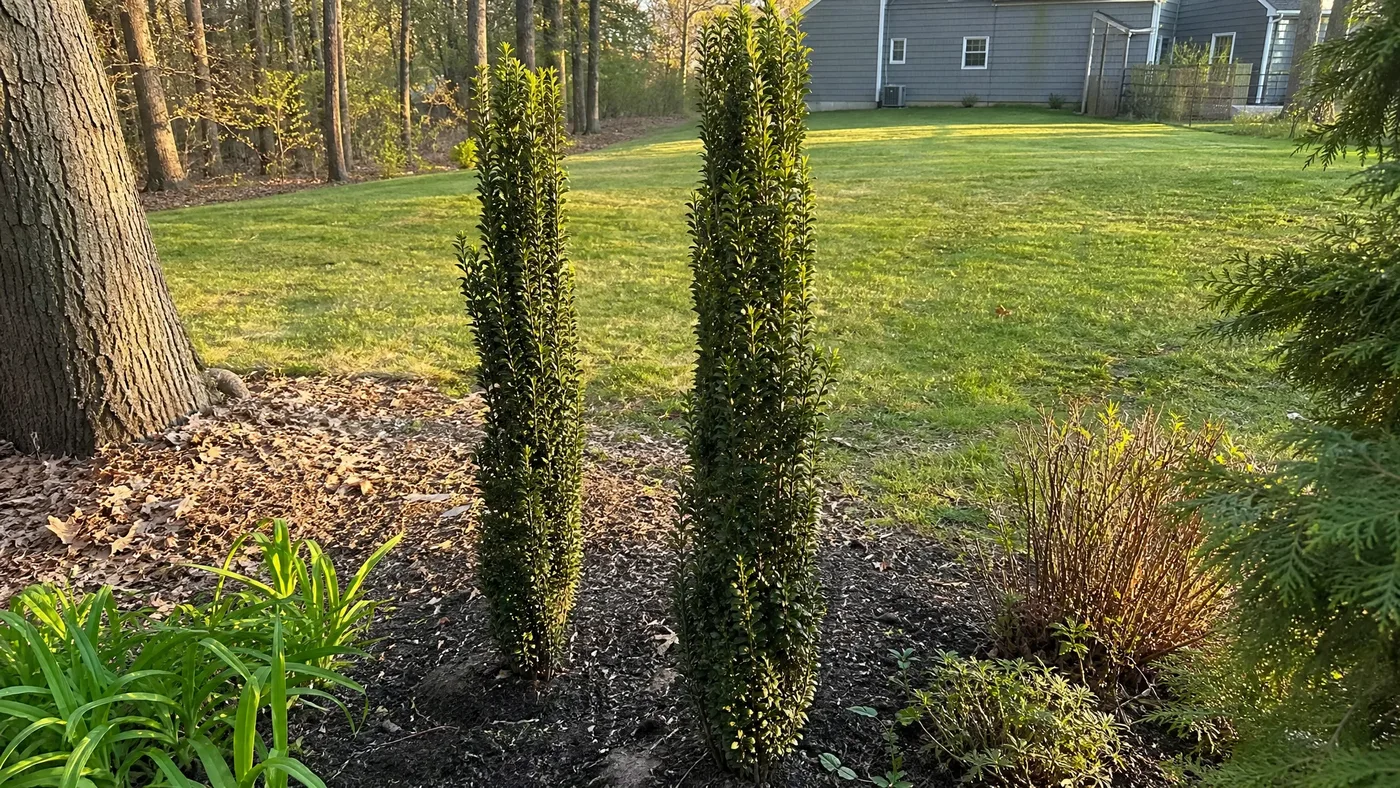
Sky Pencil Holly vs Will Fleming Holly: Size and Care
Picture a forested mountain slope in Japan, where small-leaved evergreen shrubs grow in dappled light over damp, acidic ground. Those are the wild ancestors of the box-leaf hollies. They were broad, rounded plants long before anyone planted a narrow column of them beside a front door.
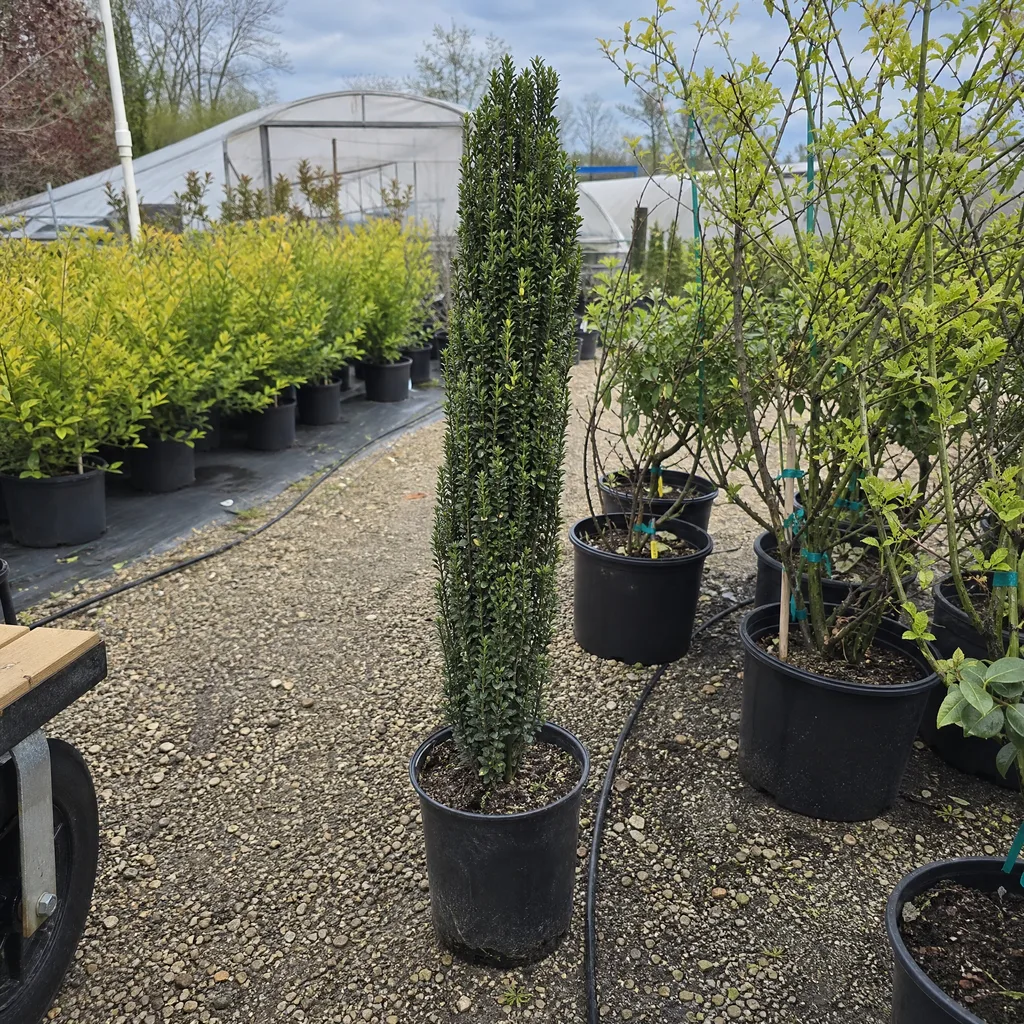
Today a shopper finds two narrow hollies on neighboring tables, both sold as tidy green exclamation points, and assumes one is a renamed copy of the other. They are not. They belong to different species from different continents, and that history decides how tall each one gets and where each one survives.
Below, you'll find out all about how Sky Pencil and Will Fleming differ, including their origins, mature size, foliage and berry traits, cold and wet limits, and how to place them in your own yard.
Japanese Mountains Behind Sky Pencil Japanese Holly
Sky Pencil belongs to Ilex crenata, a shrub native to Japan. In the wild and in most garden forms it is a rounded, densely branched evergreen. Clemson's extension service describes the Japanese hollies as usually 3 to 10 feet high with a similar spread, and says they look more like a boxwood than a holly. The small, closely set leaves suit a plant that grew in moist, slightly acidic, well-drained soil under open tree cover.
Sky Pencil is not a wild plant. It is a cultivar, a narrow upright selection kept true by taking cuttings, as with any named cultivar. We cannot document who first picked out that narrow seedling or when, so we will not guess at a story. What matters is what the selection kept and what it dropped.
It dropped the width. The species spreads 5 to 8 feet wide, while Sky Pencil runs only 1 to 3 feet. It kept the slow growth and the mountain-slope habits: moist but drained soil, and a comfort in sun or part shade that a woodland ancestor would recognize.
A Southeastern Native Called Will Fleming
Will Fleming comes from a completely different branch of the holly family. Its parent is Ilex vomitoria, the yaupon holly, a native of the warm Southeast of North America. The University of Florida lists yaupon for USDA zones 7A through 9B and rates its drought tolerance as high. Think sandy coastal ground, summer heat and salt in the air, not a damp mountain slope.
'Will Fleming' is a fastigiate male cultivar of that species. Fastigiate means the branches grow upward and hug the trunk, which is how a wide-spreading native becomes a column.
The male part matters more than most buyers expect. Yaupon is dioecious, with male and female flowers on separate plants, and only the females carry red berries. Will Fleming is a male clone, so it bears no fruit at all. It can act as a pollinizer for female hollies nearby, though, which is a useful trick if berries are what you want in the garden.
How a Name Blurred Sky Pencil Japanese Holly
The confusion starts with the description rather than the plant. Extension write-ups compare Sky Pencil to a narrow exclamation mark and say Will Fleming can act as an exclamation point in the landscape. Retail tags then shorten both to "narrow holly" or "columnar holly," and landscape plans often list just that. Once two plants share a nickname, shoppers assume they share a name.
One of the most common questions we get is whether Will Fleming is simply Sky Pencil with a different tag.
It is not, and we would push back on the advice to buy whichever one is cheaper or in stock. The advice sounds harmless because the two look alike in a 1-gallon pot. But one is rated for zones 5a through 8b and the other is a yaupon selection with a warmer range, so the wrong swap can mean a dead plant in a cold winter or a stunted one in wet clay.
The fix is simple. Read the botanical name on the label. Ilex crenata 'Sky Pencil' is the Japanese holly. Ilex vomitoria 'Will Fleming' is the yaupon. If a tag says only "columnar holly," ask which one before you buy.
What Species Heritage Means for Mature Height
Height is where the species behind each plant shows through. A Japanese holly tops out at a modest size, and even the columnar cultivar of it stays compact. A yaupon is a larger shrub or small tree by nature, and narrowing its shape does not shrink its ceiling by much.
Sky Pencil Over the Years
NC State puts Sky Pencil at 4 to 10 feet tall and 1 to 3 feet wide, with a slow growth rate. The University of Arkansas describes an 8 to 10 foot plant that is only 12 to 18 inches across. In year five, expect a plant that still has height to gain but already looks like a column. Our guide to mature size and growth rate covers the timeline in more detail.
Will Fleming Over the Years
Will Fleming grows up to 15 feet tall. Some references run taller, so plan for the high end and check with your local extension service for your area. That is up to 5 feet above Sky Pencil's usual top range.
We often see customers tuck a Will Fleming right against a wall or under a window because the tag said "narrow." Narrow is not the same as short. Give it room to reach full height and it will frame a corner. Crowd it and you will be pruning it constantly.
For screens, the same logic applies to spacing. Sky Pencil can sit close together, and our spacing guide for hedges and privacy screens explains how close. A taller yaupon column needs more air and light at its base.
Sky Pencil Japanese Holly Leaf, Berry and Bird Traits
Both plants wear small evergreen leaves, and neither has a leaf feature we would rely on to tell them apart at a nursery table. Use the botanical name instead. The flowers are also modest. Sky Pencil produces small, greenish-white, fragrant flowers in spring, though the University of Arkansas calls them of no ornamental significance. Will Fleming's flowers are the non-showy male type.
Fruit is where the two really part ways, and where the brief many shoppers carry is wrong. Will Fleming is a male clone and bears no berries. Sky Pencil sets little fruit in most plantings, and eating its berries can cause a minor toxic reaction in humans. Our guide on toxicity to pets and children goes further.
For birds, the berries are the draw. A male yaupon cannot supply them, but it can pollinate a female yaupon planted nearby, and the female's red fruit is what brings birds into a bed. Neither narrow column offers much on its own for wildlife. They are structure, and cover for the shrubs beside them.
Sky Pencil is also rated mildly resistant to deer damage. Will Fleming's sources say it has no serious pest problems.
Cold and Wet Limits Inherited From Origins
Each plant carries its home climate with it. A shrub of mountain forests handles cold and likes steady moisture. A shrub of the warm coast handles heat, drought and salt but has less margin when winter gets hard. The table sums up how that plays out.
| Condition | Sky Pencil | Will Fleming |
|---|---|---|
| Hardiness | Zones 5a through 8b | Yaupon is rated 7A through 9B |
| Wet soil | Very intolerant of poor drainage | Tolerates wet soil |
| Drought | Prefers moist, well-drained soil | Drought and salt-spray tolerant |
| Heat and humidity | Expect trouble in zones 8 and 9 | Suited to the warm Southeast |
Clemson says Japanese hollies are very intolerant of poorly drained soils and especially prone to root rot. That is the mountain-slope heritage showing: it wants moisture, but moisture that moves. Will Fleming has no such problem with wet ground, and it is easily transplanted.
On the cold side, Sky Pencil is the one to trust in zones 5 and 6, ideally with wind protection in zone 5. We would not call Will Fleming reliable below zone 7. Our hardiness zones guide covers the range for Sky Pencil in detail. In the hot, humid South, partial shade helps Sky Pencil persist.
Placing Sky Pencil Japanese Holly Beside Will Fleming
Start with your zone. The two plants overlap only in zones 7 and 8, because Sky Pencil runs 5a through 8b and yaupon starts at 7A. Outside that band, you are choosing one, not both.
Choosing One for Your Yard
- Choose Sky Pencil if you garden in zone 5 or 6, or if your bed is only a foot or two wide beside a door, a fence line or a patio.
- Choose Will Fleming if you garden in zone 7 through 9, have heavy or wet soil, hot summers, or salt spray from a coast, and want a taller screen of up to 15 feet.
- Choose Sky Pencil for a short accent around 4 to 8 feet, and Will Fleming where you need real height.
- Pick Will Fleming if you also grow a female yaupon and want it to fruit.
Using Both Together
In zones 7 and 8, the pair works well because their textures and color read as one planting. In our rows, the tall yaupon column stands at the corner or the back, and the shorter Sky Pencil repeats the shape in front. Keep Sky Pencil in the best-drained spot, and let Will Fleming take the wetter or hotter one. Our companion planting guide has ideas for filling in around them.
Two Lineages in One Garden Bed
The short version: Sky Pencil is a Japanese holly that stays slim, stays slow and handles cold. Will Fleming is a male yaupon that grows taller, takes heat, wet ground and salt, and never fruits. Pick by zone and soil first, then by height.
A naturalist's note to finish. In zones 7 and 8, a bed holding both means a mountain shrub from Japan beside a coastal shrub from the Southeast, flowering quietly in spring. Add a berried female holly nearby and the birds will find it, and they will perch in the columns as they do.
Sky Pencil Japanese Holly
Nursery-grown Sky Pencil Japanese Holly in sizes from 1-2 ft. #1 Container, shipped to your door.
From $80.55
Shop Now →We raise Sky Pencil in well-drained, slightly acidic soil, the kind of ground that suits a holly you are comparing against Will Fleming. Every plant we sell is grown on our own farms, and each one is a top-quality shrub. When you have settled on the narrow column or the taller yaupon for your bed, look over what is in stock now in our shop.