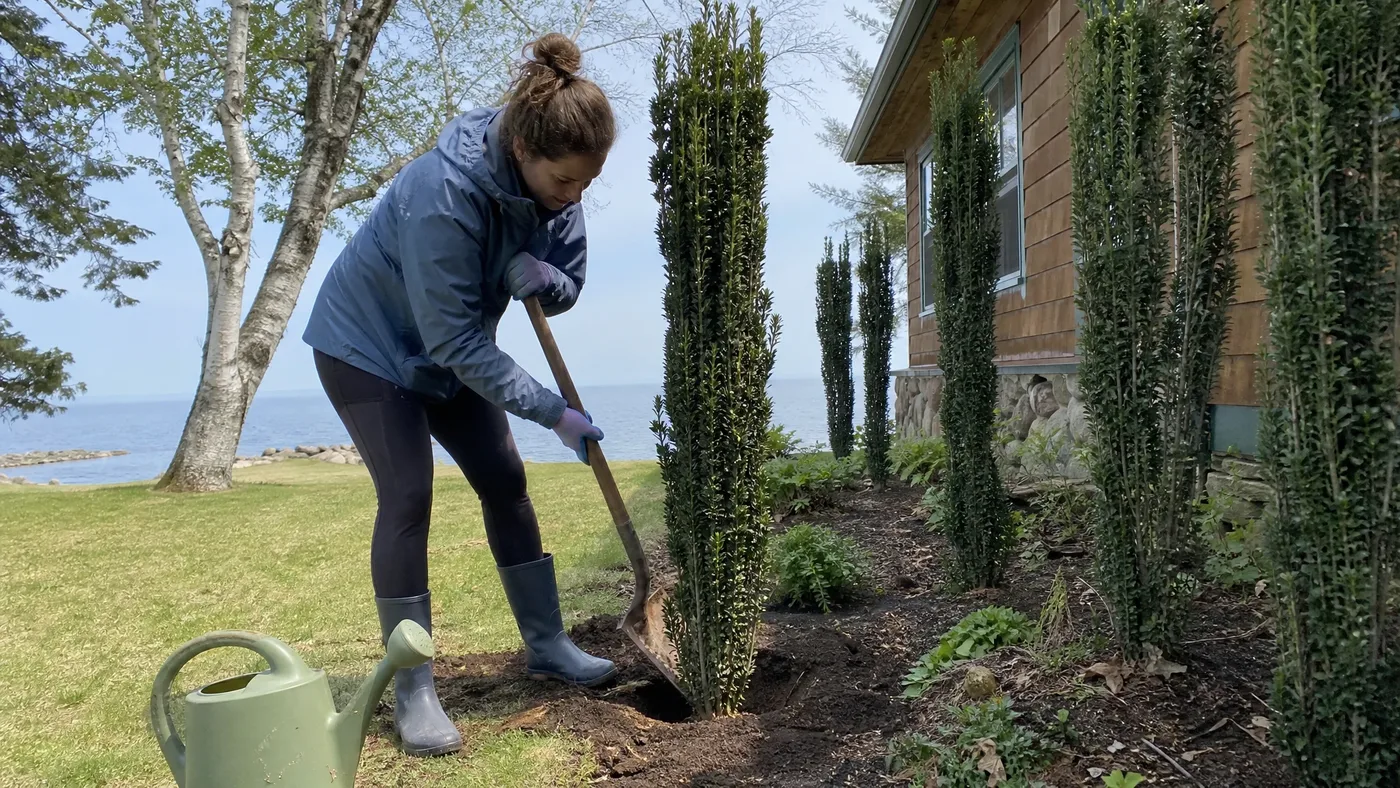
How to Transplant an Established Sky Pencil Holly
The spade is in the ground on a cool March morning, and eight six-foot hollies along a fence line have to be gone before the patio crew shows up. Most people assume a tall, established evergreen can't be moved, so they cut their losses and buy new. We see the opposite. Sky Pencil is tall but only a foot or two wide, and its roots stay compact beneath it.
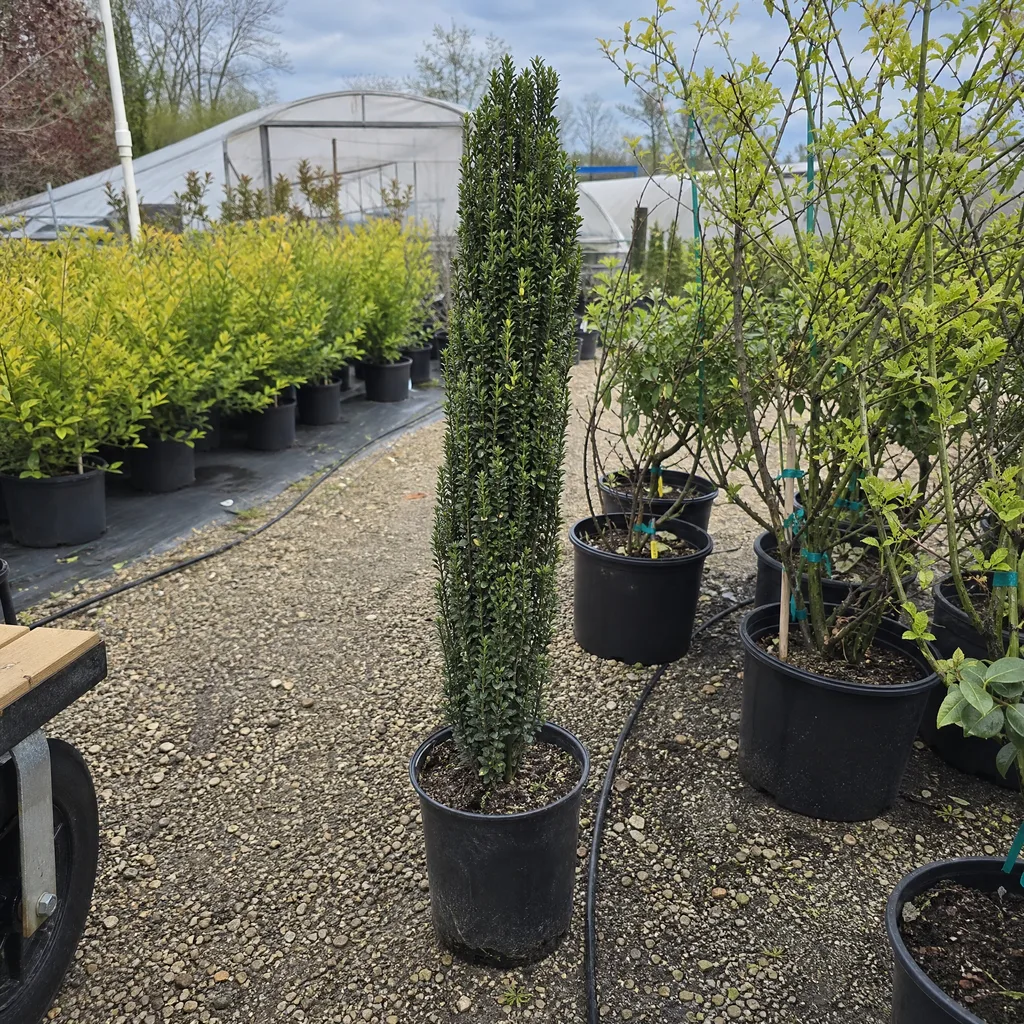
That makes it one of the more forgiving shrubs to relocate, as long as you plan the job a season ahead. This guide covers everything you need to know about moving a mature Sky Pencil, from root pruning and picking the weekend to cutting the ball, staking, and telling a stressed plant from a dying one. We follow one job all the way through.
Eight Hollies, Six Feet Tall, One Fence
Here is the job we use for every choice in this guide. Eight Sky Pencils stand in a single row along a wooden fence, each about six feet tall. Sky Pencil grows only 12 to 18 inches across, so the row looks like a line of green exclamation marks, and the plants sit close together.
They have to move about twenty feet to the edge of a new patio, where they will form a narrow screen. The old soil is heavy and slow to drain, which is the main reason to move them at all. The new spot gets sun most of the day and drains freely, which suits a plant that wants moist but well-drained, slightly acidic ground.
Gather your kit before you touch a plant: a sharp round-point spade, bypass pruners, a roll of soft cotton cord or wide strapping, burlap squares, a tarp for dragging, a wheelbarrow, a hose and a bag of mulch. Skip nylon rope for tying, because it bites into the bark and the branches. Mark the north side of each plant with a dab of paint so it can face the same way again.
Choosing the Weekend for Moving Sky Pencil Japanese Holly
Timing starts a season before the move, and it matters more than any tool you own. Moving in the dormant stretch, before new growth pushes, gives the plant the most time to rebuild roots before heat arrives. NC State lists this cultivar for zones 5a through 8b, so your exact weekend depends on where you garden. Check local frost dates with your county extension office.
Root Prune a Season Ahead
Clemson's extension says plants to be moved in spring should be root pruned in October, and fall movers should be root pruned in March. We did the October version. Push a sharp spade straight down in a circle around each plant, cutting the long roots, so the plant grows new feeding roots inside the future ball. Skip this and the plant may die from transplant shock.
Check the Weather on the Day
Moving day was a March weekend, chosen on four checks. The soil had thawed completely. No hard freeze was in the forecast for the coming week. The plants hadn't started new growth. And we picked a gray, cool Saturday so the foliage lost as little moisture as possible while the roots were exposed.
Squeeze a handful of soil first. If it holds a ball but crumbles when poked, dig. If it smears, wait a week. Fall works too if you root prune in spring, but in the colder parts of its range a fall move leaves the plant to face winter wind with a young root system, so we lean toward spring.
Sizing the Root Ball for Six-Foot Columns
A six-foot Sky Pencil needs a smaller ball than a six-foot shrub that spreads. The species can reach 5 to 8 feet wide, while this cultivar stays at 1 to 3 feet, and its roots stay tucked in close. Our root system guide explains the structure. For the move, it means a ball two people can lift, not a machine.
We don't trust any one universal diameter, only a principle: the ball must be large enough in diameter and depth to hold enough of the fibrous feeding roots for full recovery. So we scribed a circle with the spade tip noticeably wider than the foliage column, then dug down until the fibrous roots thinned out. For a number on your own plants, ask your extension office for a ball-size chart.
Broadleaf evergreens always move with soil attached, so never bare-root a holly. Dig along the October root-pruning cut, which keeps the ball tight and the roots dense. A needlessly wide ball costs you weight and a lot of dropped soil, while a ball that is too small is how a plant ends up dying of transplant shock.
You may hear that you should cut the top back to match the roots you lost. Don't do it with this plant. Its single upright shape is the whole point, and a stubbed top leaves a gap that takes years to fill.
Digging Holes Ahead of Sky Pencil Japanese Holly
Dig all eight new holes before you lift a single plant. A holly out of the ground for even an hour in a breeze loses ground fast, and you don't want to be digging while a ball sits drying on a tarp. Make each hole as deep as the ball is tall, no deeper, and about twice as wide so you can work soil back around it. String a line between two stakes first so the row runs straight.
Check drainage in the first hole. Fill it with water and watch it. If it's still standing after a few hours, fix the site before planting, because Japanese hollies are very intolerant of poorly drained soils and especially prone to root rot. In our job the soil drained freely, so the holes stayed plain.
Roughen the hole walls with the spade so they don't glaze, and leave a small firm pedestal of undisturbed soil at the bottom. Backfill with the soil you dug out, not a rich amended mix, because roots should follow the native soil outward. Keep each plant about as far from its neighbor as it stood before. The spacing guide has the details for a screen.
Lifting and Tying Each Sky Pencil Japanese Holly
A Sky Pencil's branches are upright and flexible, and they snap or splay if you lift the plant by the stems. Tying them into a tight column first protects them, and it makes the plant easy to carry. Work through each holly in this order.
- Water the plant deeply the day before so the ball holds together.
- Starting at the base, wind the soft cord up the column in a loose spiral, snug enough to gather the branches but not so tight it crushes the leaves.
- Re-cut the circle you scribed in the fall, straight down, and then undercut the ball at an angle from all sides.
- Slide a burlap square under the ball by rocking the plant gently, and pull the corners up and tie them above the soil line.
- Tip the plant onto the tarp, or lift from the ball with a helper, and move it by the ball, never by the stems.
- Set it in the new hole facing the old direction, with the top of the ball level with the ground, then cut the cord.
Customers usually ask us whether to leave the burlap on. We pull it back from the top and cut away what we can reach, since exposed burlap can wick moisture away from the surface. Leave the lower part of the wrap in the hole and backfill firmly, tamping with your boot as you go so no air pockets remain.
Watering and Staking Through the First Summer
Water each moved holly the moment it is set. Run the hose slowly at the base until the whole ball and the soil around it are soaked, and top the soil off where it settles. Keep the root ball constantly moist, not saturated. Mulch two to three inches deep, pulled back from the stem.
In practice, we watered our row every few days through the first month, then once a week through summer, always pushing a finger down beside the ball first. In a dry spell, add a day. In a rainy week, skip. Soggy soil is as bad as dry. Our watering schedule gives the long-term rhythm once the plants are settled.
Stake loosely. One stake on the windward side of each plant, with a soft tie around the middle of the column, is enough. The tie should let the stem flex a few inches, because a plant held rigid never builds the strength to stand alone. We pulled ours at the end of the first growing season.
Telling Wilt From Splay in Sky Pencil Japanese Holly
A recently moved Sky Pencil can look bad in two different ways, and they need opposite responses. Wilt is a water problem. Splay is a structure problem. Mix them up and you'll drown a plant that needed a cord, or tie up one that needed a drink. The table sets the two side by side.
| Sign | Wilt | Splay |
|---|---|---|
| What you see | Dull, curled or drooping leaves | Branches fanning out from the column |
| Likely cause | Dry ball or too many lost roots | Cord removed too early, wind or a lean |
| Check | Push a finger down beside the ball | Look from the side at the column's line |
| Fix | Water slowly, shade on hot days | Retie loosely with soft cord |
What We Did About Wilt
Two plants drooped in the first hot week of May. Both had dry balls, so we soaked them slowly and added a layer of mulch. They recovered within days. If the soil had been wet and the leaves still sagged, we would have let the ball dry slightly instead of pouring on more. Our guide on whether a plant is dead or just stressed helps when you can't tell.
What We Did About Splay
One holly opened up after a windstorm. We wrapped it again with soft cord for a few weeks and didn't prune it. Cutting at that stage only leaves gaps, and our pruning guide covers the later, careful trims.
Eight Sky Pencil Japanese Holly Plants a Year Later
A year on, all eight stood in the new line, and the row looked as if it had always been there. Expect no big jump in height. NC State notes a slow growth rate, so the first season goes to roots, not stems.
We learned three things. Root pruning in the fall earned its place, and we'd never skip it. Soft cord beats any tape or wire. And we'd mark every plant's north face before digging, since two of ours went in rotated and needed a lean corrected. Next time we'd also dig the holes a week ahead, so a rain test of drainage has time to run.
If you lose a plant despite good care, fill the gap with a new one rather than rearranging the row. We grow Sky Pencil for exactly that kind of job, and a replacement goes in the same way as the plants you moved.
Keep the Line Straight and the Water Coming
Moving a Sky Pencil comes down to a few habits: root prune a season ahead, cut a ball wider than the foliage column, dig the new holes first, tie the branches softly and carry the plant by its ball. Stake loosely and read the leaves. Eight plants standing straight along the new line is the reward, and the one thing left to do is keep watering through the first dry spell.
Sky Pencil Japanese Holly
Nursery-grown Sky Pencil Japanese Holly in sizes from 1-2 ft. #1 Container, shipped to your door.
From $80.55
Shop Now →We raise our Sky Pencil on our own farms, in well-drained ground with plenty of sun, and we dig and handle every plant much as we described here. Before a plant leaves us, we look over its roots, its branches and its shape. Every shrub we send is top quality, so if you'd like a Sky Pencil for your own garden, choose one from our shop.