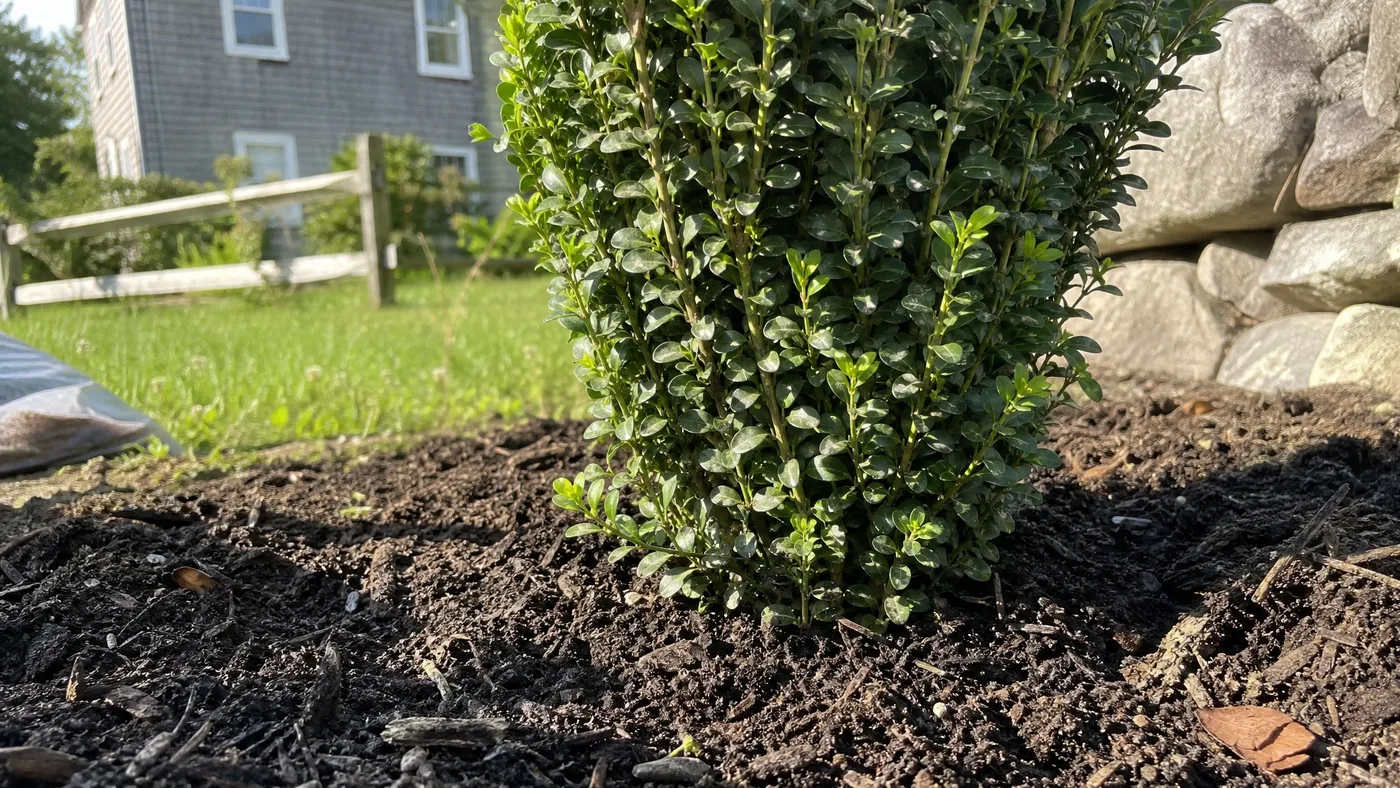
Sky Pencil Holly Root System: Depth, Spread and What to Avoid
It starts underground. Slide a Sky Pencil out of its nursery pot and the soil falls away from a tight mat of fine, pale roots that holds the shape of the container and not much more. No thick anchor, no long runners, just a dense little ball that looks far too modest for a shrub standing 8 to 10 feet tall.
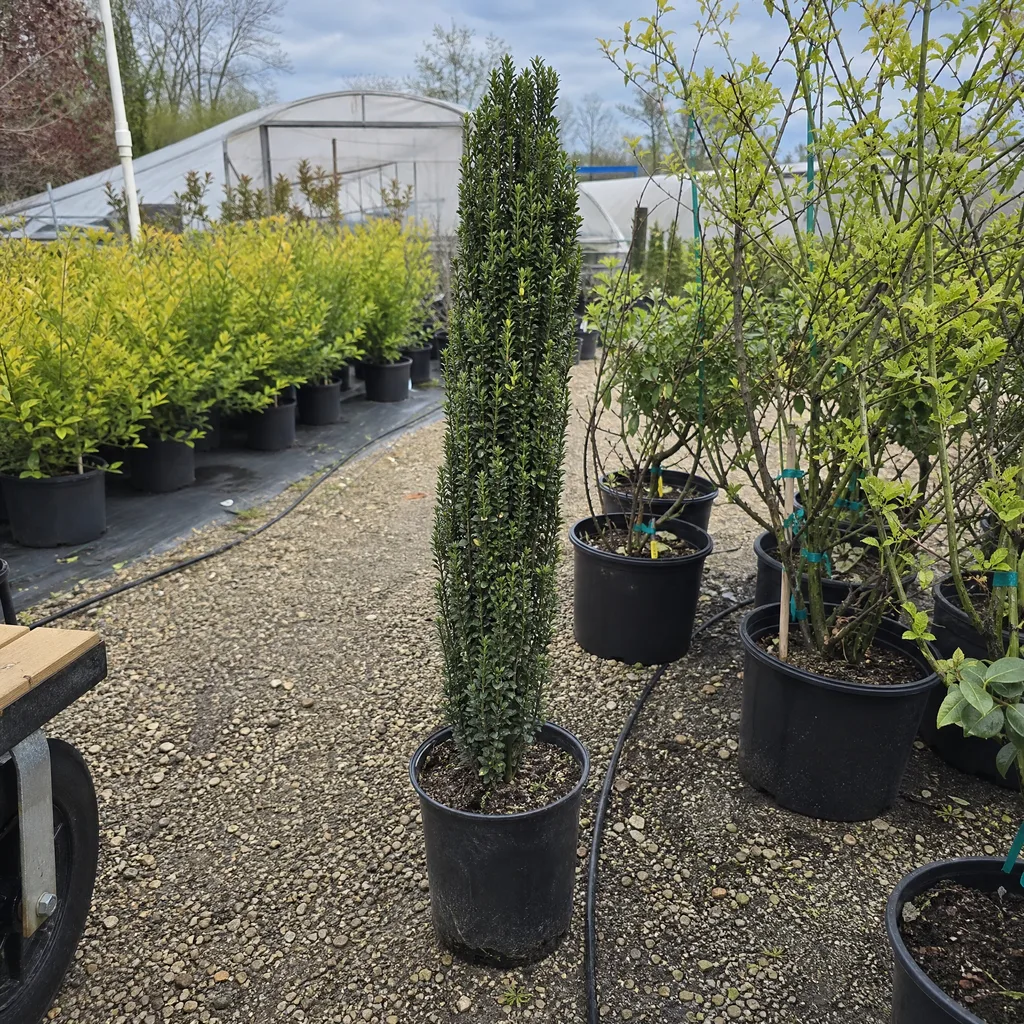
That picture is the best answer we have to a question customers put to us all the time: how deep and how far will the roots go, and will they bother my pipes, my walk or my foundation? The plant's own build settles most of it, so we begin there.
Below, you'll find out all about the Sky Pencil root system, including how the fibrous mass forms, where the feeder roots sit, how little room they claim, safe distances from hardscape and buried lines, and the habits that actually hurt them. Done well, a slim green column stays upright and tidy for years. Done badly, a small root ball has little reserve to fall back on.
How Sky Pencil Japanese Holly Builds a Fibrous Root Mass
Japanese hollies, the species behind this cultivar, grow a fibrous root system rather than a taproot. Dozens of fine roots branch again and again close to the base of the stem, forming a mat that fills the soil right around the plant instead of plunging down into it. Clemson's extension notes that Japanese hollies look more like a boxwood than a holly, and the root habit matches that tidy, compact character.
Sky Pencil takes that habit and scales it to its shape. The top is a slow-growing column, and the roots grow at the same unhurried pace. There is no flush of coarse roots racing outward to feed a wide canopy, because there is no wide canopy to feed. The root mass and the foliage above it stay in proportion.
Fine roots do two things well. They absorb water and nutrients across a large surface in a small volume, and they recover quickly when a plant is moved, which is part of why extension sources call Japanese holly easy to transplant. They also dry out fast and cannot reach far for water in a dry spell. Both traits shape everything else in this guide.
The species and the cultivar part ways here. A typical Japanese holly grows into a broad mound, and its roots spread to support it. Sky Pencil was selected to stay narrow, so its roots have never been asked to cover that much ground.
Where the Feeder Roots Actually Sit
Most of the roots that do the feeding sit in the top layer of soil, the same layer your mulch, compost and watering reach. Fibrous roots follow oxygen and moisture, and both are richest near the surface, so a Sky Pencil does not send roots chasing water deep underground the way a taproot tree might. We cannot hand you one reliable depth in inches, because the soil decides it, and your local extension service can tell you what is typical for your ground.
Why Soil Type Changes the Picture
In loose, organic soil the root mass fills out evenly and may reach a little deeper. In heavy clay or compacted fill the roots stay shallow and tight because there is little air below. Japanese holly tolerates clay and poor soils, but tolerating is not thriving. A bed of improved soil under the plant gives those fine roots more to work with, and our soil guide shows how to build it.
What Shallow Roots Mean for Care
Shallow, fine roots dry out before deep soil does, so a Sky Pencil in a hot, dry week shows stress sooner than the shrubs around it. Slow, thorough watering at the base wets the feeding zone without leaving it soggy, and mulch holds that moisture in place. One of the most common mistakes we see is deep, infrequent soaking aimed at roots that were never deep.
Set the top of the root ball level with the surrounding soil, as our planting guide walks through. Burying the crown smothers exactly the roots that matter most.
Spread Stays Narrow, Like the Crown Above
Picture the plant from above: a circle of foliage only 12 to 18 inches across, topping a column 8 to 10 feet tall. It can reach a mature width of 1 to 3 feet, a little more generous but still slim. The root zone follows that outline closely, reaching somewhat past the edge of the foliage rather than far beyond it.
That narrow footprint is the whole reason the plant works in tight places. You can run a Sky Pencil along a gate, flank a doorway or stitch a row of them through a border, and the roots will not shoulder aside their neighbors the way a spreading shrub's would. The dark vertical line stays crisp, and the soft textures planted at its feet, such as ferns, sedges or low groundcovers, keep their own room underground.
For rows, the same logic lets you plant close. Roots of adjacent plants barely meet when you follow the numbers in our spacing guide. In a drought, young perennials planted tight against the stem will compete for the same thin layer of water, so keep a small ring of open mulch around each trunk and water that zone first.
Why the Invasive-Roots Myth Misses Sky Pencil Japanese Holly
The reputation comes from other plants. Large shade trees and a few rambling shrubs really do send thick, searching roots into drains and under paving, and the stories attached to them drift onto shrubs in general. Hollies get swept in because the name covers everything from tall trees to small hedging plants, and the worry follows the name instead of the plant.
Set that against what this plant does. The species reaches a mature width of 5 to 8 feet, while Sky Pencil stays at 1 to 3 feet. Even the broad species occupies a modest patch compared with a shade tree, and the cultivar occupies a fraction of that. It does not sucker, it does not run, and it does not build thick woody roots that heave concrete.
One of the most common questions we get is whether a Sky Pencil can lift a sidewalk, and we tell people no, because the plant simply does not grow that kind of root. The blanket advice to keep every shrub as far from the house as a tree is overcautious for a column this slim.
Roots do cause real trouble on this plant, but the trouble runs the other way. The roots are the vulnerable part, and the dangers come from wet soil and rough handling, which the later sections cover.
Safe Distances From Foundations, Pipes and Walks
None of the extension sources we rely on gives a fixed distance for this cultivar, so we reason from the numbers that do exist: a mature width of 1 to 3 feet and a fine, shallow, compact root mass. Because the roots stay close, the distances that matter are practical ones, meaning room to reach the plant, air around the foliage, and space for a crew to dig nearby later.
The table pairs each feature with what the roots do and what we tell customers.
| Feature | What the roots do | What we tell customers |
|---|---|---|
| Foundation wall | Fine roots stay near the base and exert no real pressure on masonry | Plant far enough out that the foliage clears the wall and you can reach every side |
| Buried water or sewer lines | Small, shallow roots are unlikely to force into sound pipe, but a leak will draw them | Keep clear of known leaks and septic fields, and locate lines before digging |
| Sidewalks and driveways | The mat is too narrow and fine to build structure under paving | Set the plant back so the mature column does not brush people walking by |
| Overhead and buried utilities | Roots are not the issue, height is | Call your utility locator before digging, and check overhead lines against a mature height of 8 to 10 feet |
The one place we ask for extra care near a house is wet ground. A holly planted under a downspout or in a spot where the gutters dump water sits in saturated soil, and that harms the roots far more than they will ever harm the wall. If the spot is too tight for a ground planting, a pot sidesteps the question, and our guide to growing Sky Pencil in containers covers it.
What Harms the Roots of Sky Pencil Japanese Holly
The fine root mass that makes Sky Pencil a safe neighbor also makes it easy to hurt. A handful of ordinary habits do nearly all the damage, and most of them are easy to avoid once you know the roots are shallow.
Soggy Soil and Root Rot
Clemson's extension says Japanese hollies are very intolerant of poorly drained soils and especially prone to root rot. Fine roots drown first, because waterlogged soil has no air in it. The foliage yellows and drops while the soil still looks green and healthy on top, which fools many owners into watering more. Low spots, heavy clay and runoff areas are the usual causes, and our problems guide covers how to recognize the disease.
Compaction, Mulch and Trenching
The remaining threats are physical, and they all come down to what happens in the top layer of soil.
- Compaction. Foot traffic, wheelbarrow routes and parked equipment squeeze the air out of the root zone, so keep paths and stepping spots outside the foliage line.
- Deep mulch against the stem. Mulch piled up the trunk holds moisture on the crown and smothers the roots below, so spread a modest, even layer and pull it back from the stem.
- Trenching nearby. Cable runs, irrigation lines and edging cuts slice through a small mat that has little reserve, so mark the plant and dig well outside the foliage line.
- Nematodes. Nematodes turn up among the occasional pests, and they feed on roots, so healthy, well-drained, evenly watered soil is your best defense.
Roots of Sky Pencil Japanese Holly Reward Gentle Handling
Everything above comes down to light and space. Think of the root mass as a small stage under a tall actor. It needs open, well-drained soil around the base and a sunny to lightly shaded spot above, which the extension sources agree this holly accepts. A small root ball does not need a huge hole, but it does need a clean one with no soggy pockets.
Give the column room to be seen. Leave a ring of open mulch at its base, keep a narrow bed of low plants beside it, and hold paths and trenches outside the foliage line. Placed this way, the dark vertical shape rises from a quiet, uncluttered base, and the roots below can work in peace.
Handle the ball as you would a delicate thing. Lift it by the container, not the stem, loosen the outer roots only lightly, set it level with the soil, and water it in slowly. A fibrous mass settles fast when it is not disturbed, and after that the best care is often to leave it alone.
Planting Sky Pencil Japanese Holly Without Root Worry
Sky Pencil builds a fibrous, shallow, narrow root mass that tracks its slim crown, which is why it will not threaten foundations, pipes or walks. The real risks run the other way: wet soil, compaction, mulch piled on the stem and trenching close to the plant. Keep those four in check and the roots take care of themselves.
Picture the root ball years from now, still a compact mat close to where you set it, with the column rising slowly overhead and nothing beneath it going anywhere. It stays put, year after year.
Sky Pencil Japanese Holly
Nursery-grown Sky Pencil Japanese Holly in sizes from 1-2 ft. #1 Container, shipped to your door.
From $80.55
Shop Now →Good roots begin in the field, where we set our Sky Pencil in bright sun or light shade, in loose soil that drains freely and leans a little acidic. Top-quality shrubs raised and sold straight from our own farms are all we offer, and this holly is one of them. If this guide has you ready to give those roots a place to settle, begin with a Sky Pencil from us.