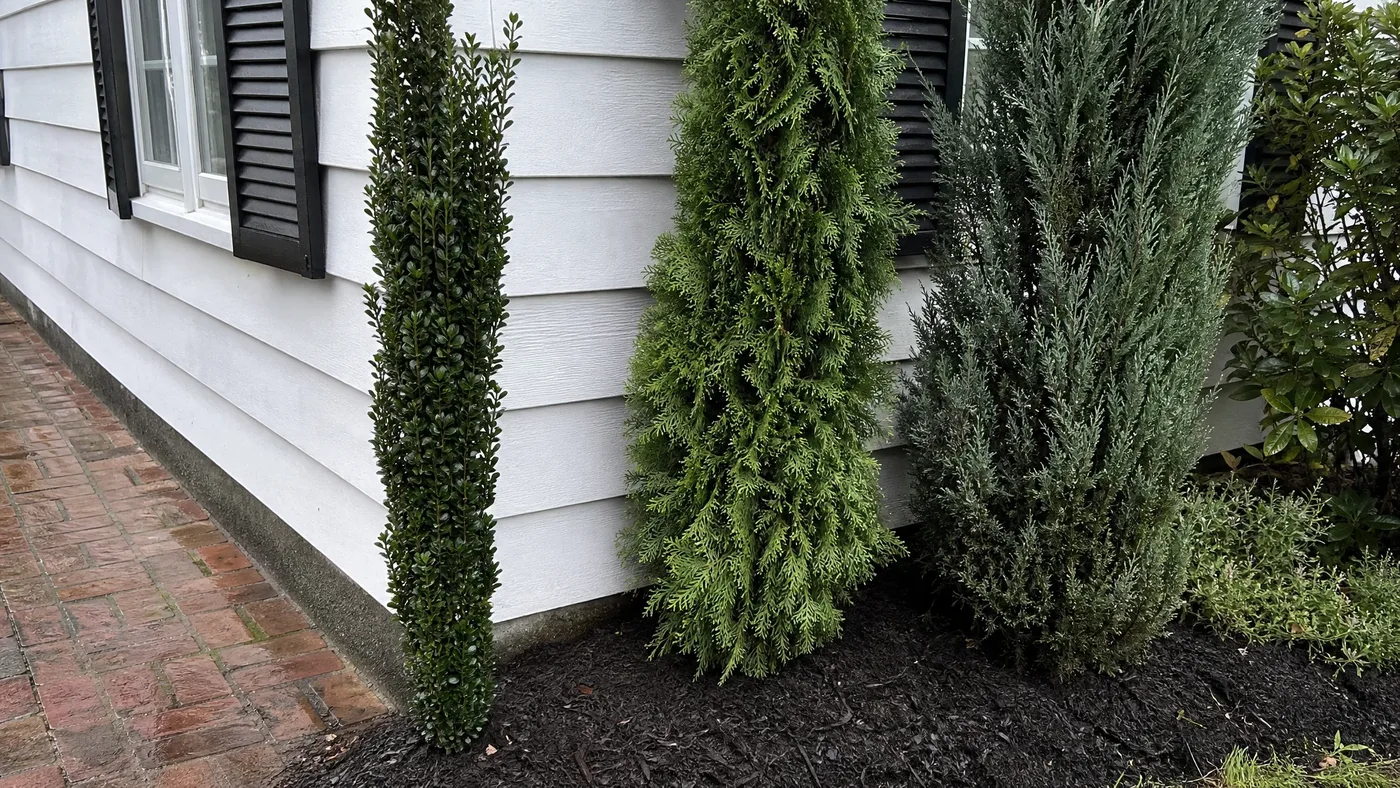
Sky Pencil Holly Alternatives: Other Narrow Evergreens
A customer called us this spring after striking out at every nursery in reach. Sky Pencil was sold out everywhere, and they wanted to know if anything decent could stand in. It is a fair question, because Sky Pencil does something few shrubs manage. It grows 8 to 10 feet tall yet stays only 12 to 18 inches across, and that is the bar every substitute has to clear.
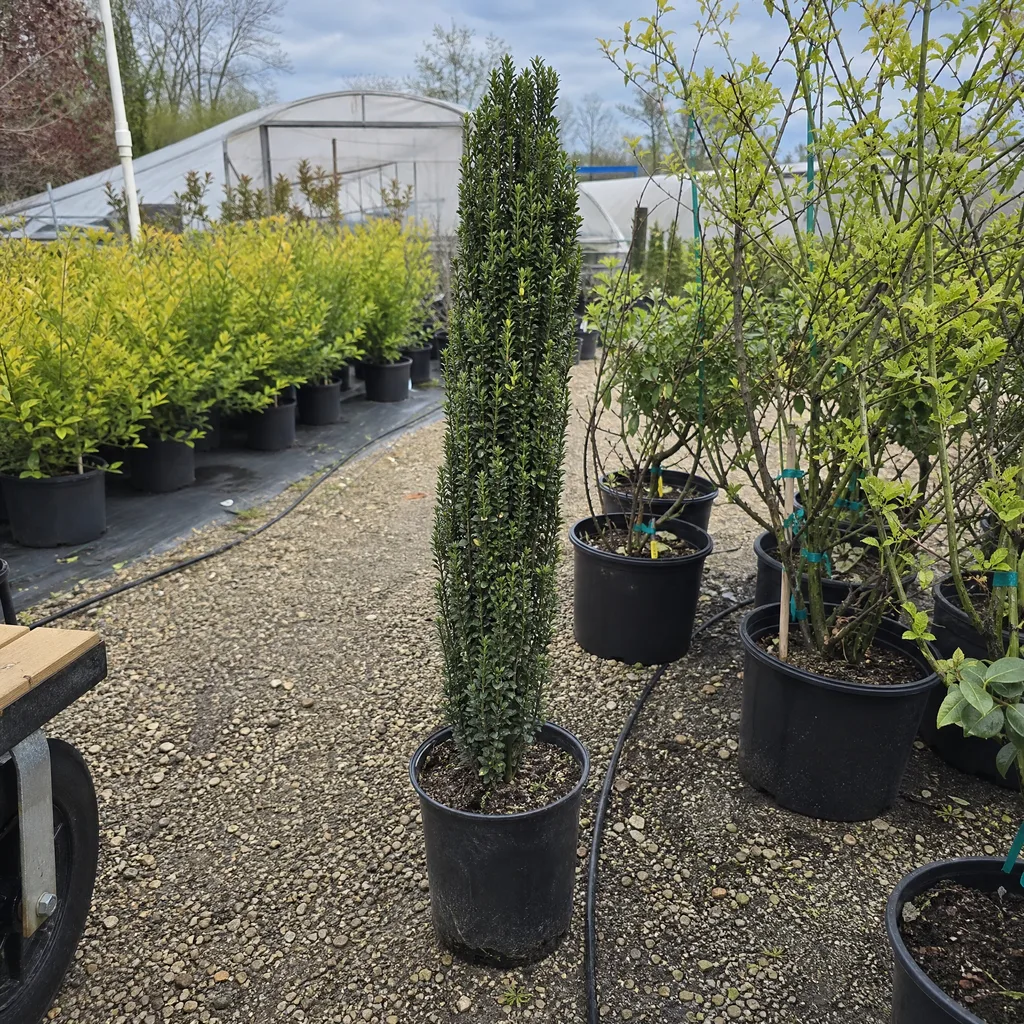
No stand-in matches it exactly, but several come close enough for a screen or an entry accent. We'll walk you through size, cold hardiness, soil, upkeep and winter look for arborvitae, skyrocket juniper, Will Fleming holly and Red Sky holly, then help you pick the one that fits your yard. Pick wrong and you get a plant that flops under snow, browns in a wet spring, or outgrows its spot in a few years.
How Tall and Slim Each Substitute Gets
Height is easy to match. Width is where most substitutes give ground, and width decides how many plants fit along a fence and how much room you need to leave for them. Here is how the group lines up, with Sky Pencil as the benchmark.
| Plant | Mature height | Mature width | Fit verdict |
|---|---|---|---|
| Sky Pencil | 8–10 ft typical | 12–18 in | The benchmark, and the slimmest of the group |
| Will Fleming holly | 12–15 ft | 2–3 ft | Closest in shape, but taller and wider |
| Arborvitae | Varies widely by cultivar | Usually wider than Sky Pencil | Good for a tall, solid screen |
| Skyrocket juniper | Tall and pencil-like | Narrow but looser | Good for a dramatic accent |
| Red Sky holly | Check the plant tag | Check the plant tag | Worth a look if you find it labeled narrow |
Will Fleming grows 12 to 15 feet tall and 2 to 3 feet wide. It is a yaupon holly, so it is a different species from Sky Pencil, and it makes a taller, bolder exclamation point. It suits a tall wall or a two-story corner better than a tight bed under a window.
Arborvitae is where sizes jump around, because the cultivars range from compact to very tall. Oregon State calls arborvitae tall, narrow, evergreen, low maintenance and inexpensive. Read the tag for the mature width, since many run wider than Sky Pencil's slim column.
Skyrocket juniper reads as the most pencil-like of the group, though its outline is looser. We could not verify sizes for Red Sky holly, so go by the tag on the plant or ask your local extension office before you build a planting plan around it.
Cold Hardiness Next to Sky Pencil Japanese Holly
Sky Pencil has a middle-of-the-road range. NC State lists it for zones 5a through 8b, while Oregon State says hardy to zone (5) 6, so zone 5 is the edge rather than the comfort zone. Our hardiness zones guide goes deeper on where it thrives.
Where Winter Is the Problem
Sky Pencil's winter damage is mostly wind burn on exposed foliage, not dead wood. Penn State Extension lists Japanese holly for zone 6, or zone 5 with wind protection, and we tell zone 5 customers to plant on the lee side of a house or fence.
Will Fleming: It has the same 5a to 8b range, so it offers no extra cold margin. Verdict: an equal, not an upgrade.
Arborvitae and skyrocket juniper: both generally go colder than Sky Pencil, which is why they are the usual answer for zone 4 and exposed prairie sites. Cultivar ratings vary, so check the tag. Verdict: the better choice in the coldest zones.
Where Summer Is the Problem
The other end matters too. Sky Pencil can run into heat and humidity trouble in zones 8 and 9. In those hot, humid summers a juniper often does worse than a holly, because junipers dislike muggy air. Will Fleming, from a holly native to the Southeast, is the one we would try first in the deep South. Red Sky is unknown territory here, so confirm its zone rating before you buy.
Soil and Moisture Tolerance Beyond Sky Pencil Japanese Holly
Soil is where Sky Pencil is more forgiving than some of its substitutes, and less forgiving than others. The University of Arkansas extension asks for well-drained, slightly acidic soil with a good base of organic matter, and Sky Pencil also does fine in neutral soil. That tolerance for a range of pH is a real strength.
The weak spot is water that stays. Clemson says Japanese hollies are very intolerant of poorly drained soils and are especially prone to root rot. If your yard stays soggy after rain, raise the bed or choose a different plant. Our soil and amendment guide covers the fixes.
Arborvitae and Juniper
Arborvitae tends to cope with damper ground better than Sky Pencil does, so it is our usual answer for a low spot with a wet spring. Skyrocket juniper is the opposite. It wants sharp drainage and full sun, and it sulks in the part shade that Sky Pencil takes in stride. On a north side or under a tree canopy, Sky Pencil is the more forgiving choice by a wide margin.
The Hollies
Will Fleming is a yaupon holly, a tougher and more adaptable species than Japanese holly in general reputation, so it may tolerate a broader mix of conditions. Treat that as a tendency and confirm with your local extension service. We have no verified soil notes for Red Sky, so give it the same well-drained, slightly acidic bed you would give Sky Pencil and you will be safe.
Shearing, Staking and Other Upkeep Demands
Sky Pencil is a slow grower, which is the main reason it needs so little from you. It holds its column without shearing, and a light tidy once a year covers it. Our pruning guide shows where to cut. Here is how the others compare.
- Arborvitae needs the least from you in most yards, though heavy snow can pull the branches outward, so knock snow off or loosely tie the stems before a big storm.
- Skyrocket juniper is the one most likely to splay open after a wet snow, and it usually needs tying in the first few winters to keep its pencil shape.
- Will Fleming grows faster and taller than Sky Pencil, so expect to snip stray stems every year or two to keep it slim at 12 to 15 feet.
- Red Sky should be treated like a holly. Plan on an annual look-over for pests and a light trim, and read the tag for its growth rate.
We often see customers tie a juniper too tight, which cuts into the bark and leaves a pinched waist. Use soft ties, loose enough to let the stem move, and take them off in spring.
Pests are part of upkeep too. Spider mites and nematodes are occasional pests for Sky Pencil, so check the foliage in hot, dry spells. Our winter care guide covers the cold-season tasks. Verdict: arborvitae wins on low effort, Sky Pencil is next, and juniper asks the most.
Texture and Winter Color Compared With Sky Pencil Japanese Holly
Sky Pencil is a Japanese holly with small, dark, glossy leaves, and Clemson says Japanese hollies look more like boxwood than a holly. The result is a fine, dense texture that stays the same green all winter. It does not bronze or yellow, and its spring flowers are of no ornamental significance, so there is nothing to miss when they pass.
Arborvitae has flat, scale-like sprays that give a softer, feathery look. Many cultivars take on a bronze or brownish cast in cold winters, which some people like and some find dull. If you want steady green, that shift can disappoint you.
Skyrocket juniper is the most different. Its foliage is blue-gray to gray-green and slightly prickly, so it stands out from a green hedge and can look cool and silvery in winter. Pair it with other blue or gray plants rather than a row of dark green, or it will look out of place.
Will Fleming looks the most like Sky Pencil. It is a holly with small leaves and a dark, evergreen look, only larger and slightly looser. Red Sky should read as a holly too, but check it in person if you can, since texture varies by selection. Verdict: Will Fleming is the closest match for look, and arborvitae is a pleasant but different one.
Choosing a Substitute for Sky Pencil Japanese Holly
Every call we take ends with the same question: which one should I plant? Here is what we tell customers, one situation at a time.
Tight bed, narrow space: Sky Pencil is the only truly slim option, so wait for it if the space is under 2 feet wide. For a bit more room, Will Fleming works.
Very cold or windy site: choose arborvitae. It is the dependable pick when zone 5 or colder winters worry you.
Wet or shady spot: arborvitae suits a damp site, while shade points back to the holly family. Skip juniper in both.
Hot, dry, sunny spot: skyrocket juniper does best here and gives you a cool gray-blue accent.
If you cannot get Sky Pencil at all, try Will Fleming holly first. It matches the shape, the leaf and the evergreen look, and it shares the 5a to 8b range. Just give it more height and width. If you would like a different style entirely, our Italian cypress comparison covers another tall, slim option. We grow Sky Pencil ourselves, so ask if you want to know when more is ready.
A Close Second Still Makes a Good Screen
Match the substitute to your site, not to a picture. Choose arborvitae for cold and wet, juniper for sun and dry ground, and Will Fleming when you want the holly look at a bigger scale. Any of them gives you a narrow evergreen screen that looks good in year five, even if it is not a perfect copy. If you are unsure about your site, ask us and we will help you sort it out.
Sky Pencil Japanese Holly
Nursery-grown Sky Pencil Japanese Holly in sizes from 1-2 ft. #1 Container, shipped to your door.
From $80.55
Shop Now →Our growers keep Sky Pencil in well-drained, slightly acidic soil in full sun to part shade, and watch through the year for spider mites and soggy ground. As a small grower-run business, we only ship plants we would plant ourselves. Take a look at the shrubs we have ready whenever you are.