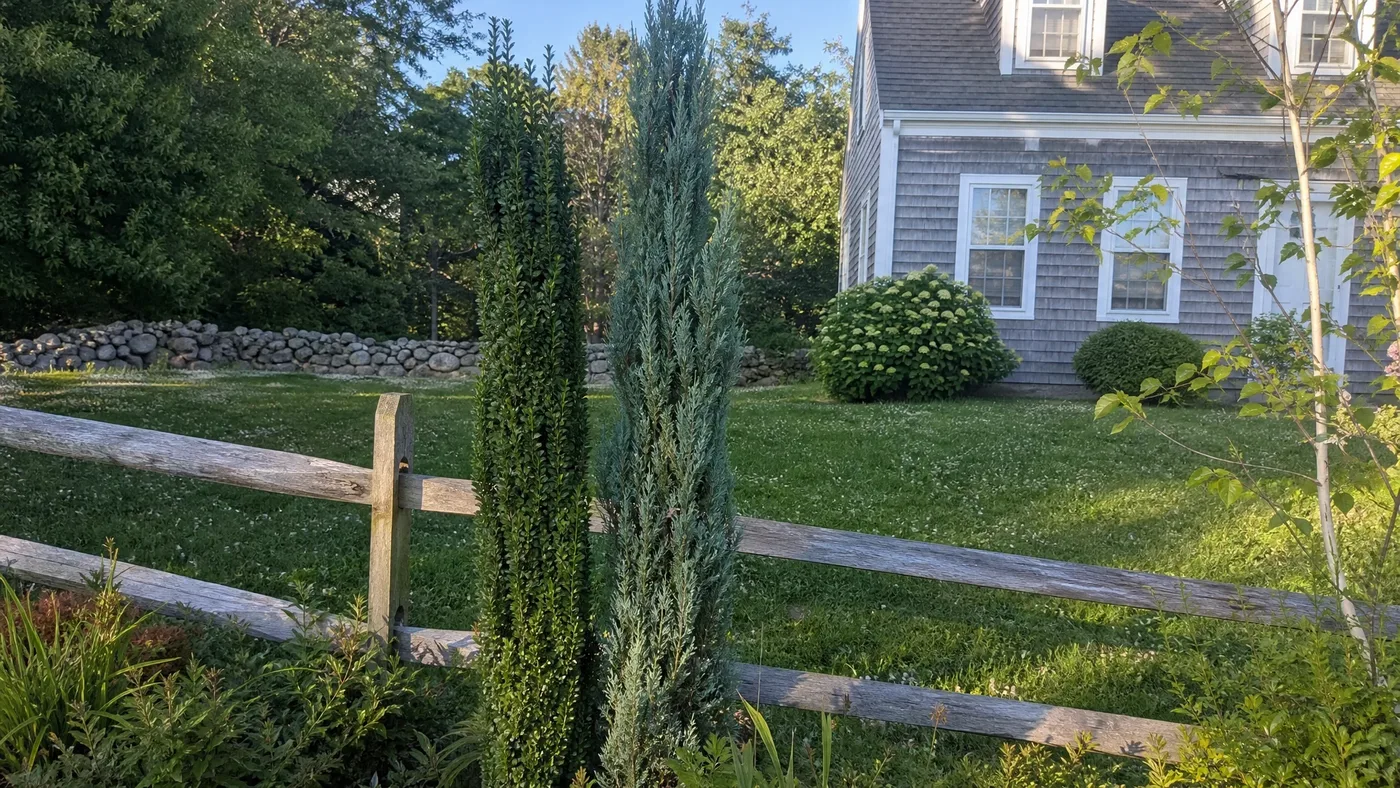
Sky Pencil Holly vs Blue Arrow Juniper: Sun and Shade Needs
Plenty of shoppers treat these two as interchangeable because both are tall, thin and evergreen. We doubt it. A shared silhouette says nothing about what happens in a particular yard, and the two plants come from different families with different habits.
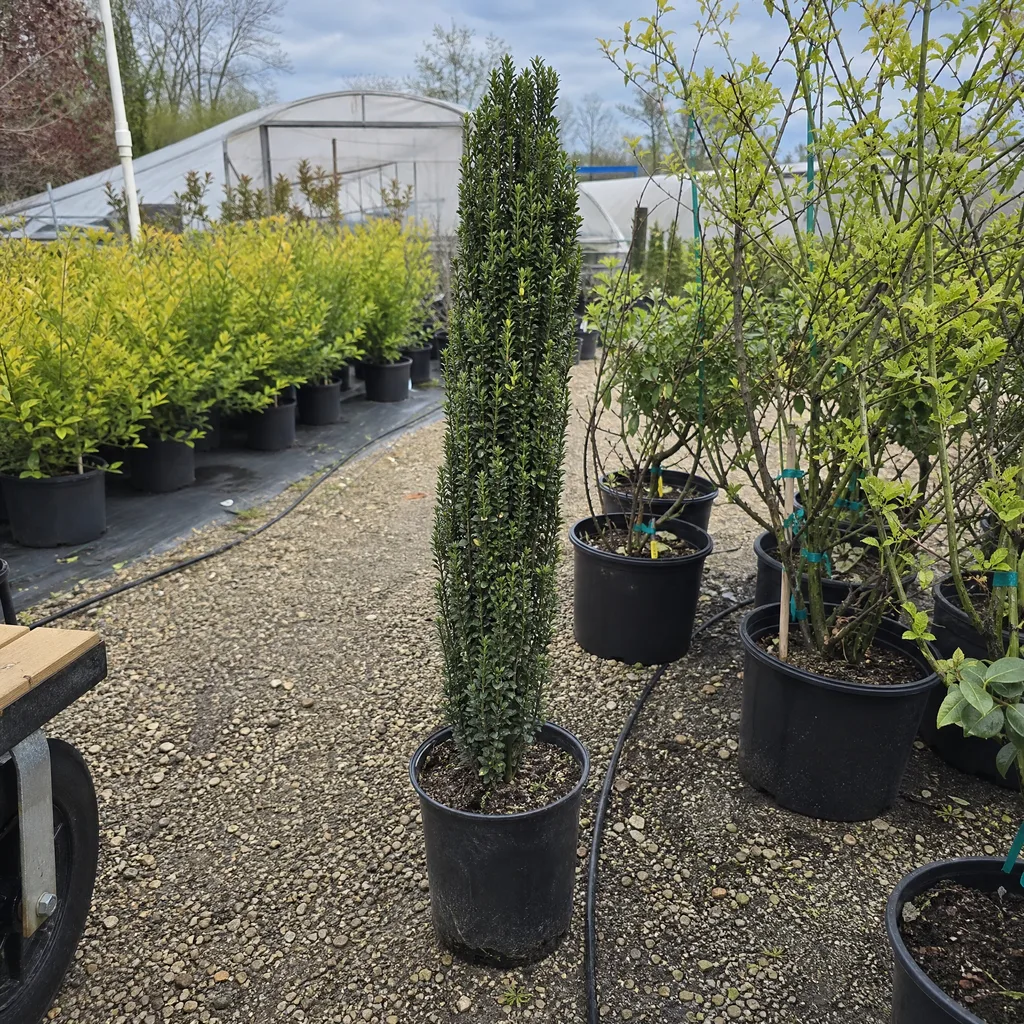
Sky Pencil is a Japanese holly (Ilex crenata) cultivar, a broadleaf shrub that Clemson's extension says looks more like a boxwood than a holly. Blue Arrow is a juniper, a conifer usually placed in the Rocky Mountain juniper group, and that heritage shapes everything below.
This article talks about how each plant handles sun, shade, wind, heat, wet soil and pests across four common yards and answers the questions customers ask us most. Read on to learn which one fits a shaded side bed, a windy corner, a hot deck and a damp clay spot, and where the claims on plant tags run ahead of the evidence.
A Narrow Side Bed Between Two Houses
Picture a bed barely wide enough for a shovel, with a fence on one side and a wall on the other, where the sun clears the roofline for only part of the day. This is where the two plants part ways fastest, and it is the situation customers describe to us most often.
Why the Juniper Struggles Here
Utah State's tree browser lists Rocky Mountain juniper, the group Blue Arrow is usually placed in, as shade intolerant. We take that at face value. A sun-loving conifer in a side bed is the plant we expect to thin out first, with lower and inner foliage browning while the tips reach for light.
We have no measured timeline for Blue Arrow itself, so we can't say whether that takes two seasons or five. The direction is not in doubt.
What Sky Pencil Tolerates
Sky Pencil works in full sun, meaning six or more hours of direct light, and in partial shade. Oregon State says sun to part shade, and Arkansas extension says light to moderate shade. Notice what none of them say: deep shade. A canyon between two houses that sees direct sun only in June is not part shade.
The holly also fits the space physically. Arkansas extension describes it as 8 to 10 feet tall and only 12 to 18 inches across, and it grows slowly, so it will not crowd the wall. Expect it to be a little looser than the same plant in full sun, since the most compact growth comes in a sunny spot.
Our verdict: if the bed gets fewer direct hours than your gut says, plant the holly. Our guide to Sky Pencil sun requirements shows how to measure the light before you buy.
Sky Pencil Japanese Holly on a Windy Corner Lot
The wind claim we hear most is that a stiff blue juniper shrugs off gusts while a soft-leaved holly gets shredded. We looked for a source on either half and found none. The extension pages behind our facts do not measure wind damage for Sky Pencil or for Blue Arrow, so treat any confident line on a plant tag with suspicion.
One of the most common questions we get is whether a corner lot rules out a holly. It does not, but exposure shows up first as a cold problem, and that is where the numbers help.
Cold first. NC State lists Sky Pencil for zones 5a through 8b, and Penn State Extension gives Japanese holly as zone 6, or zone 5 with wind protection. That parenthetical matters on a corner. At the cold edge of its range, an exposed evergreen holly is the plant a winter gale hurts.
Utah State gives Rocky Mountain juniper zones 3–7, which reaches two zones colder than the holly's 5a floor. If your corner sits in zone 4, the juniper wins on hardiness alone.
Height and slow growth. At 8 to 10 feet tall and 12 to 18 inches across, a mature Sky Pencil is a slender pole. It grows slowly, so a young plant on an exposed corner has little wood to resist a push. What we tell customers is to stake loosely through the first seasons and to plant where a house or fence breaks the prevailing wind. Our winter care guide covers siting in cold climates.
Our call. In zone 5 or colder with open exposure, choose the juniper. In zones 6 to 8 with any windbreak at all, the holly is a sound choice, and its evergreen leaves hold their look through winter.
A Pot on a Hot Southwest Deck
A southwest deck is the harshest test here. You get strong afternoon sun, heat bouncing off boards and siding, and a small root zone that dries fast. This is where the holly's gentler reputation runs into trouble. Our guide to growing Sky Pencil in pots covers the basics of containers.
Heat is where this plant's range thins. Georgia extension says Japanese hollies in zone 7 persist better in partial shade, and heat and humidity cause trouble in zones 8 and 9. The species page calls Japanese holly drought tolerant, but that describes an established plant in the ground, not a root ball in a pot.
On light alone, the juniper wins this spot, since it wants the sun the deck delivers. We have no source on how Blue Arrow handles reflected heat or a baking pot, so pot size and watering still matter for it.
If you pot a Sky Pencil for this deck, here is what we would do:
- Choose a pot with drainage holes and lift it on feet, because root rot is the holly's weak point in any soggy mix.
- Place it where it gets morning sun and afternoon relief, even if that is only the far end of the deck.
- Check it by hand every few days in summer and water when the mix feels dry below the surface.
- Keep it off the hottest wall, where reflected heat scorches leaves and dries the pot from the sides.
Spider Mites and the Juniper Unknowns
Hot, dry, reflected heat is spider mite weather. Sky Pencil gets spider mites and nematodes only occasionally, and UMass Extension says Japanese holly is subject to mite infestations under hot, dry conditions. Scale, bud moth and leafminers are also common holly pests, so look at the undersides of leaves now and then.
For the juniper, we found no source tying Blue Arrow to a specific pest, and we won't call it pest free. Ask your county extension office what is active on junipers near you.
Our call: for a deck that bakes from noon to dusk, we lean juniper. For a deck with afternoon shade, the holly is the better-behaved pot plant.
Wet Clay Beside a Downspout
A downspout bed combines what Sky Pencil dislikes most in one place: clay that holds water and a pipe that adds more. Clemson's extension says Japanese hollies are very intolerant of poorly drained soils and especially prone to root rot. We believe it.
Clay itself is not the problem. Japanese holly tolerates poor and clay soils, but clay that drains and clay that pools are different soils. We often see customers blame the plant for yellowing that started in a soggy planting hole.
Soil chemistry adds a second filter. Arkansas extension asks for well-drained, slightly acidic soil with a good base of organic matter, and the cultivar wants acid soil below pH 6.0. On Japanese holly, alkaline soils will cause the leaves to yellow. Junipers are generally thought to be more forgiving of alkaline soil, though we have no sourced pH range for Blue Arrow, so test before you assume.
Yellow leaves can mean alkaline soil or root rot, and they look alike from a distance. This is how we would read the spot:
| What you find | What it means | What we would do |
|---|---|---|
| Water still standing in a test hole the next morning | The soil cannot drain | Extend the downspout, plant on a mound or move to another spot, for either plant |
| Soil test reads alkaline | Holly leaves are likely to yellow | Choose the juniper, or put the holly elsewhere |
| Soil test reads acid (below 6.0) and drains | Inside the holly's preferred range | Plant the holly and work in organic matter |
| Leaves yellow after planting | Alkaline soil or root rot | Check the roots and the pH before treating |
Our planting guide walks through setting the root ball at the right height. In a truly wet spot, fix the water first and choose the plant second.
Sky Pencil Japanese Holly Where the Evidence Runs Thin
Plant tags repeat each other, and so do websites. When we traced the common claims back to extension sources, some held up and some turned out to be borrowed from the species or from a neighboring plant.
The cultivar and species differ more than the tags suggest. Sky Pencil grows 1 to 3 feet wide, while the species reaches 5 to 8 feet. The shade, drought and clay tolerance on the species page describes a wide shrub, so we apply it to Sky Pencil only as a working assumption.
Here is how the usual claims hold up:
| Claim | What the sources show | Our read |
|---|---|---|
| Thrives in shade | Sun to part shade, light to moderate shade | Part shade yes, deep shade no |
| Pest free | Occasional spider mites and nematodes on the cultivar, plus scale, leaf miners, aphids and leaf blight on the species, though no serious pests | Low pressure, not none |
| Hardy to zone 5 | 5a–8b, (5) 6 from Oregon State, best in 7–9 from Arkansas | Sources disagree, so treat zone 5 as borderline |
| The juniper is carefree in any sun | Only shade intolerance and zones 3–7 for the species group | Blue Arrow data is thin |
The Juniper Numbers We Won't Give You
Every juniper figure in this guide comes from the Rocky Mountain juniper group, not from testing of Blue Arrow. We have no sourced size, pest list or pH range for it, so we have not given one. If you want to widen the field, our guide to other narrow evergreens is the place to start.
Choosing for Your Own Yard With Sky Pencil Japanese Holly
Our verdicts, with caveats. Side bed: Sky Pencil, since the juniper is rated shade intolerant. Windy corner: let winter decide, as the juniper's zones 3–7 beat the holly's 5a–8b in the cold. Hot deck: the juniper for pure sun, the holly only with afternoon relief. Wet clay: neither until the water is fixed, then the holly if the soil is acidic and the juniper if it is alkaline.
Still, trust your own site's light and drainage over any label, ours included. Watch the spot for a full day, fill a test hole with water and test the pH before you buy either plant. Then describe your yard to us, and we will gladly say which one we would plant.
Sky Pencil Japanese Holly
Nursery-grown Sky Pencil Japanese Holly in sizes from 1-2 ft. #1 Container, shipped to your door.
From $80.55
Shop Now →Our Sky Pencil spends its days in loose, well-drained, slightly acidic ground rich in organic matter, with bright light on its narrow green column. We grow and sell top-quality shrubs from those same farms. Once you have matched the holly or the juniper to your sun and shade, we would love for you to start with a Sky Pencil of ours.