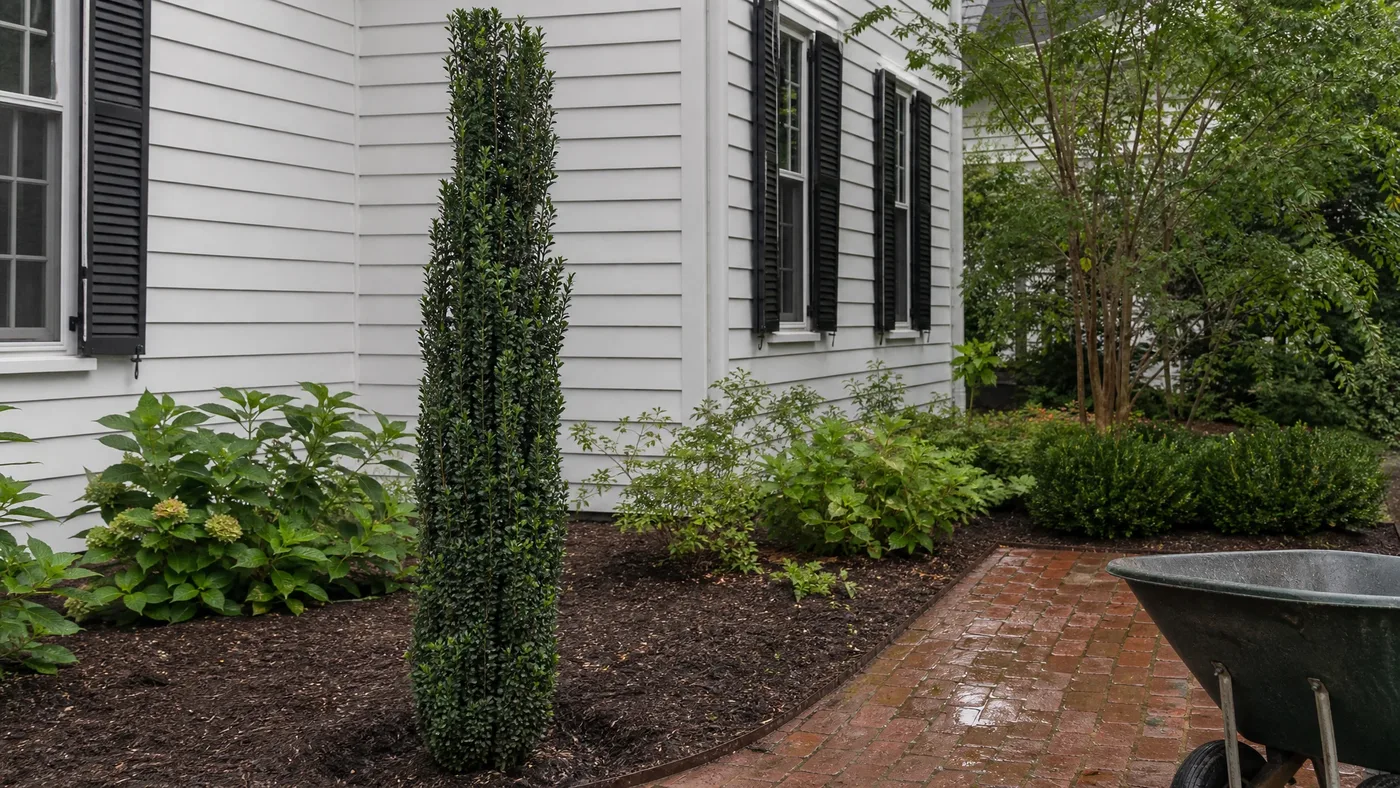
Sky Pencil Japanese Holly Care Guide: Everything You Need to Know
Most Sky Pencils we see struggling were planted where the soil dries out, then watered on a guess. Customers often tuck them into a thin strip beside a driveway or wall, where the roots bake and the plant browns from the bottom up. Others do the opposite and park them in a soggy corner. Either way, the slim column you paid for turns gappy long before year five.
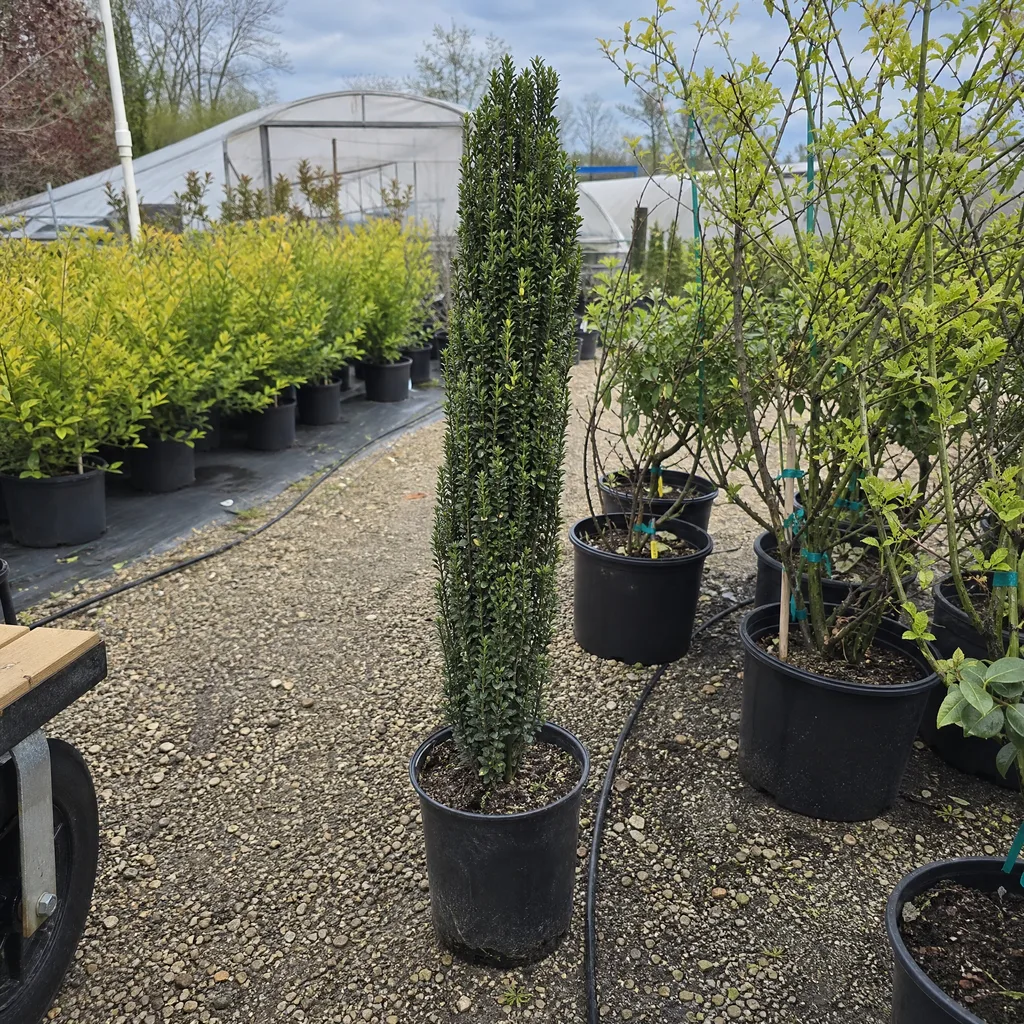
Set up right, this holly gives a lot back. It is a narrow evergreen exclamation point that holds its shape through every season. In this article, we'll go through watering and drainage, site and planting, light, pruning, feeding and winter care, and the problems we see most often. We'll finish with how to use it in screens, entries and pots.
Water Sky Pencil Japanese Holly Evenly and Keep the Soil Drained
Moisture is where this plant is least forgiving, so we start here. Get the soil and the watering rhythm right and most other care gets easier.
Sky Pencil Japanese Holly requires consistent moisture. Unlike drought-tolerant plants, it does not tolerate prolonged dry periods once established. At the same time, waterlogged soil leads to root rot, particularly the fungal disease black root rot.
Soil Preparation
Good soil does half the watering work for you. Prepare the planting area before the plant goes in.
Sky Pencil Japanese Holly performs best in moist, well-draining soil rich in organic matter. The ideal texture is loamy or sandy loam. Before planting, amend your native soil with 2 to 3 inches of compost or aged bark mulch worked into the top 8 to 12 inches. This improves drainage in clay soils and water retention in sandy soils.
Aim for acidic to neutral soil, which suits this cultivar, with a pH ideally between 5.0 and 6.5. If your soil is alkaline (above 7.0), the plant may develop chlorosis, a yellowing of leaves due to iron unavailability. In strongly alkaline soils, either amend heavily with sulfur-based products or consider growing Sky Pencil Japanese Holly in a container.
Watering Schedule
Water newly planted specimens weekly during the first growing season, providing 1 to 2 inches per week if rainfall is insufficient. In zones 6 to 7, this typically means weekly deep watering from planting through September. Reduce frequency as temperatures cool in fall.
Once established (after one full growing season), water during dry periods when the top 1 to 2 inches of soil feel dry to the touch. This is typically every 7 to 10 days in summer, depending on rainfall and temperature. Reduce watering frequency in fall and winter when the plant is dormant.
One of the most common questions we get is how often to water. Our answer is to check the soil, not the calendar. Push a finger in 2 inches, and water only if it feels dry. Our simple watering schedule goes into more detail.
Soil Maintenance
Maintain the 2 to 3-inch mulch layer year-round, renewing it annually as it breaks down. Mulch conserves moisture, regulates soil temperature, and suppresses weeds. However, keep mulch 3 to 4 inches away from the stem to prevent rot and pest issues.
Monitor soil pH annually if your native soil trends alkaline. If chlorosis appears (yellowing between leaf veins with green veins), apply a chelated iron product according to label directions and consider acidifying the soil with sulfur.
What Sky Pencil Japanese Holly Looks Like in Year Five
Knowing the mature shape helps you judge spacing, site and pruning before you plant.
Sky Pencil Japanese Holly is a columnar cultivar of Ilex crenata, an evergreen shrub native to Japan, Korea, China, and Taiwan. This particular selection was bred in Japan to achieve an exceptionally narrow, upright form that has become increasingly popular in American landscapes over the past two decades.
What sets this plant apart is its growth habit. Unlike most hollies that spread and branch widely, Sky Pencil Japanese Holly maintains a pencil-thin silhouette naturally. It produces small, glossy dark green leaves densely packed on upright stems, creating a refined columnar profile that looks as striking in winter as it does in summer.
Sky Pencil reaches 4 to 10 feet tall, and most plantings settle at 6 to 8 feet. The width stays at just 1 to 3 feet, while the species spreads 5 to 8 feet. Growth is slow, so a small nursery plant takes years to reach screen height. A standard boxwood hedge might sprawl 4 to 8 feet wide, while Sky Pencil solves the problem of designing with limited horizontal space.
Why We Recommend Sky Pencil
Three reasons come up again and again with the customers we talk to.
First, it offers vertical accent and interest without requiring much ground footprint. A skinny columnar form draws the eye upward, making narrow borders feel taller and more purposeful.
Second, it is an evergreen, so it provides structure and color year-round. Winter leaf bronzing or purpling can occur in exposed sites, but the foliage stays intact.
Third, it responds well to both formal and modern designs. Its refined geometry suits minimalist landscapes and contemporary architecture equally well.
Choose the Site and Plant Sky Pencil Japanese Holly
Timing, hardiness and light decide how well your plants establish. Below we cover those first, then the planting steps.
Timing and Hardiness
Plant Sky Pencil Japanese Holly in spring or fall, avoiding peak summer heat. Spring planting (March through May in most zones) gives the plant the full growing season to establish roots. Fall planting (September through November) works equally well, provided you plant at least 6 weeks before the first hard frost to allow root establishment.
Sky Pencil is hardy to USDA zone 6, and sheltered sites in zone 5 can work. At the warm end, it struggles with heat and humidity in zones 8 and 9, so choose a spot with good airflow there.
Light and Site
Choose a location in full sun to part shade. In USDA zones 6 to 8 where this plant thrives reliably, full sun (6 or more hours of direct sunlight per day) produces the densest, most compact form. However, in hot southern climates (zone 8), afternoon shade or dappled sun helps reduce leaf bronzing and stress during extreme summer heat.
Ensure the site has good air circulation and is not subject to heavy snow load or ice accumulation. While the plant is hardy, its narrow form can splay open or lean under the weight of wet snow or ice, particularly in sites with insufficient light.
Full Sun (6+ hours)
Full sun produces the most compact, densest form and deepest green foliage. In zones 6 and 7, or in cool maritime climates, full sun is ideal. The plant tolerates it well and rarely experiences heat stress.
Part Shade (3 to 6 hours)
Part shade works well, especially in zone 8 or in areas with intense afternoon sun. Dappled sun or morning sun with afternoon shade reduces leaf bronzing and heat-induced stress without compromising growth significantly. However, excessive shade (fewer than 3 hours per day) causes the plant to become leggy, thin, and less columnar.
Sites to Avoid
Do not plant Sky Pencil Japanese Holly in deep shade (fewer than 3 hours of direct sun). In low light, the plant's narrow form tends to open up or splay, defeating the reason you chose this cultivar. Additionally, poor air circulation in shaded sites increases disease pressure.
Planting Steps
Follow these six steps for each plant, working through them in order.
| Step | Action |
|---|---|
| 1. Dig hole | Dig a hole as deep as the root ball and 1.5 times as wide. Loosen the sides and bottom so roots penetrate easily into surrounding soil. |
| 2. Position plant | Place the plant so the top of the root ball is level with the ground. The base of the stem (the flare where roots diverge) should be visible above soil. |
| 3. Backfill | Fill the hole with amended soil. Water as you backfill to eliminate air pockets. Do not compact forcefully. Let water settle the soil. |
| 4. Water deeply | Apply 1 to 2 inches of water to settle the soil and establish contact between roots and soil particles. |
| 5. Mulch | Apply 2 to 3 inches of mulch (shredded bark or compost) around the base, keeping it 3 to 4 inches away from the stem. |
| 6. Spacing | Space plants 1.5 to 2.5 feet apart for a narrow hedge or screen. Use wider spacing if growing individual specimens as accents. |
We often see Sky Pencils planted too deep, with the stem flare buried under soil or mulch. Keep the flare visible and the plant stays healthier.
Prune Sky Pencil Japanese Holly Lightly or Not at All
One of the greatest appeals of Sky Pencil Japanese Holly is that it requires minimal pruning. Its naturally columnar habit means you get a narrow form with almost no intervention. This differs sharply from traditional hedges that need multiple shearings per year.
You will often read that columnar hollies should be sheared every year to keep them tight. We don't follow that advice with Sky Pencil. Shearing on a schedule leaves flat-cut tips and a stiff, clipped look that this plant does not need. We trim only stray stems. Our guide to pruning Sky Pencil without ruining its shape has more.
When to Prune
Light shearing or shaping is best done after the spring growth flush, in late spring to early summer (typically May to early June in zones 6 to 7, and June to early July in zone 8). This timing allows you to remove new growth and maintain compactness without triggering tender new growth late in the season.
Avoid heavy pruning in late fall or early winter. Cutting severely in October, November, or December can stimulate tender new growth that winter cold will damage, weakening the plant.
Pruning Methods
For most situations, no pruning is necessary beyond occasional dead-wood removal. If the plant begins to look too wide, lightly shear the sides with hand pruners or hedge shears, removing no more than the current season's growth. Step back frequently to assess the form and maintain symmetry.
Do not cut into old brown wood. Sky Pencil Japanese Holly does not reliably regenerate from severe pruning into bare wood. Light, annual pruning of new growth is far preferable to heavy renovation pruning.
Feeding Sky Pencil and Seasonal Care
This is a light feeder with simple seasonal needs. Fertilizer timing matters more than amount, and winter care is mostly about snow.
Fertilizing Schedule
Sky Pencil Japanese Holly is not a heavy feeder. Light annual feeding in early spring (March to April in zones 6 to 7) is usually sufficient. Use a balanced fertilizer (such as 10-10-10) or an acid-forming fertilizer formulated for hollies or azaleas (such as 15-10-10).
Established plants often need little supplemental feeding if they are mulched and growing in decent soil. Newly planted specimens benefit more from spring fertilizing during their first two years. Once established, skip fertilizing if the plant appears healthy and vigorous.
Avoid fertilizing late in the growing season (after August). Late-season nitrogen can stimulate tender growth that winter cold will injure.
Customers often ask us whether extra fertilizer will speed it up. It won't. Growth is slow by nature, and extra nitrogen mostly gives you soft growth that suffers in winter.
Seasonal Considerations
In winter, monitor plants in zones 6 to 8 for heavy snow or ice accumulation. If wet snow builds up on the narrow columnar form, gently brush it off to prevent splaying or breakage. Do not prune frost-damaged foliage until late winter or early spring, after the threat of hard frost has passed.
In zone 8, where Sky Pencil Japanese Holly can experience occasional winter bronzing or purpling of foliage, this is normal. The color typically reverts to deep green as temperatures warm in spring. This damage is mainly cosmetic and does not indicate poor health.
Common Sky Pencil Problems and How to Fix Them
Most problems trace back to water, light or winter weather. Start with the cause before reaching for a spray.
Pests
Spider mites and nematodes are the occasional pests on Sky Pencil. Spider mites appear during hot, dry periods and cause stippled, yellowing foliage. Spray affected plants with a strong stream of water or apply insecticidal soap according to label directions.
Scale insects appear as brown bumps on stems and leaves, so prune out heavily affected branches or treat with dormant oil in late winter. Leaf miners create pale blotches inside leaves, and no treatment is usually necessary unless damage is severe. Nematodes work on the roots, so mulch and steady moisture are your best defense.
Diseases
Black root rot (caused by Thielaviopsis) is the most serious disease. It occurs in waterlogged, poorly draining soils. Prevention is the key. Ensure well-draining soil and never allow the plant to sit in standing water. If root rot occurs, dig the plant and replant in amended, better-draining soil.
Leaf spot diseases also occur in humid, poorly ventilated sites, so improve air circulation and prune lower branches to allow air to flow around the base. Powdery mildew is occasional and typically not serious enough to require treatment.
Winter Stress and Bronzing
In exposed sites with cold winter winds, foliage can bronze or purple. This is normal in zones 6 and 7, particularly on the windward side. Plant in a sheltered location if possible, or provide a burlap screen on the north or windward side during the harshest months. The foliage will return to normal green color in spring.
Splaying and Loss of Form
If the plant leans open or splays, it is usually growing in too much shade or has been damaged by heavy snow. Improve light exposure if possible. In areas with significant snow, plant in a location with better wind protection, or use a sturdy burlap cage around young plants in winter to shed snow and ice.
Chlorosis
Yellowing between leaf veins while veins remain green indicates chlorosis, usually caused by iron deficiency in alkaline soil. Apply chelated iron according to label directions and work sulfur into the soil to lower pH. In strongly alkaline sites, container growing may be more practical than attempting to amend soil.
Containers and Landscape Uses for Sky Pencil
A pot or a planting bed can both show off the narrow form. Each calls for a slightly different routine.
Growing in Containers
A pot suits this plant well, but it changes your watering and winter routine. Our guide to growing Sky Pencil in pots and containers covers more.
Sky Pencil Japanese Holly is well suited to container growing, thanks to its narrow footprint. A mature plant needs a container at least 18 to 24 inches tall and 12 inches in diameter (a 6 to 11-gallon pot).
Use a high-quality potting soil that drains well but retains some moisture. Water regularly, checking soil moisture daily in summer. Container plants dry out faster than in-ground specimens and may need watering every 2 to 3 days during hot weather. In winter, reduce watering but do not let soil completely dry out.
In zones 6 to 7, move containers against a south-facing wall or into an unheated garage in the coldest months to protect roots from freezing. Container roots have less insulation than in-ground roots and can die if exposed to extreme cold. Alternatively, bury the entire pot in the garden soil and mulch heavily.
Fertilize container plants lightly every 4 to 6 weeks during the growing season, as watering leaches nutrients from potting soil faster than from garden soil.
Formal Hedges and Screens
A row of Sky Pencils makes a screen that takes almost no ground. By year five, expect an evenly filled column rather than a finished wall.
Space plants 1.5 to 2.5 feet apart (closer spacing creates a denser screen more quickly) to form a narrow hedge or living screen. This works particularly well where space is tight, such as between a property line and a narrow pathway. Unlike traditional 4 to 8-foot-wide hedges, a Sky Pencil Holly screen can be squeezed into a 2 to 3-foot-wide space. Rooting cuttings from your own plant is an inexpensive way to fill a long screen.
Many sources say to plant them 1 foot apart for an instant wall. We don't, because crowded plants compete for water and lose lower foliage. See our spacing guide for hedges and privacy screens for more.
Foundation and Entry Plantings
Flank a doorway or window with single specimens or pairs. The vertical accent draws the eye upward and frames the entrance formally. Pair it with lower companions such as hostas, heuchera, or dwarf boxwoods for textural variety.
Grow a single Sky Pencil Japanese Holly in a prominent pot near an entry, on a patio, or at the corner of a raised bed. Its narrow form makes it an excellent choice for small spaces where traditional shrubs would overwhelm the area.
Contemporary and Modern Gardens
Sky Pencil Japanese Holly complements modern landscape design. Its geometric form, narrow silhouette, and year-round presence suit minimalist gardens with clean lines, gravel, steel or concrete elements, and limited plant variety.
Companion Planting
Pair Sky Pencil Japanese Holly with plants that offer textural or color contrast. Good companions include hosta (for broad leaves and shade tolerance), azalea (for spring color and similar soil preferences), boxwood (for traditional formal gardens), hydrangea (for complementary form and seasonal interest), ferns (for fine-textured foliage), and heuchera (for colorful foliage year-round).
Sky Pencil Japanese Holly Quick Reference
Use this table as a checklist when you plan, plant and maintain your hollies.
| Care Factor | Recommendation |
|---|---|
| Hardiness | USDA zones 5 to 8, most reliable in zones 6 to 8 |
| Mature Size | 4 to 10 feet tall, 1 to 3 feet wide |
| Growth Rate | Slow |
| Planting Season | Spring or fall, avoiding summer heat |
| Spacing | 1.5 to 2.5 feet apart for hedges, wider for specimens |
| Sun Exposure | Full sun to part shade, with afternoon shade in hot, humid zone 8 |
| Soil Type | Moist, well-draining, loamy or sandy loam |
| Soil pH | Acidic to neutral, ideally 5.0 to 6.5 |
| Watering (Established) | Every 7 to 10 days in summer, less in fall and winter |
| Pruning | Minimal, light trimming in late spring to early summer only |
| Fertilizing | Light annual feeding in early spring with balanced or acid-forming fertilizer |
| Deer Resistance | Mild, not deer-proof in high-pressure areas |
| Container Suitable | Yes, use a 6 to 11-gallon container and water frequently |
| Years to Maturity | Slow, expect years rather than seasons |
| Lifespan | Long-lived with steady moisture and good drainage |
| Key Companions | Hosta, Azalea, Boxwood, Hydrangea, Ferns, Heuchera |
Steady Water and Room Keep Sky Pencil Slim for Years
Water this holly on the soil, not the calendar, and give it drainage, six hours of sun in cooler zones and afternoon shade where summers are hot and humid. Space it 1.5 to 2.5 feet apart, trim only stray stems, and feed lightly in early spring. Do those few things and it keeps its narrow shape year after year.
Sky Pencil Japanese Holly
Nursery-grown Sky Pencil Japanese Holly in sizes from 1-2 ft. #1 Container, shipped to your door.
From $80.55
Shop Now →Customers come back to us for Sky Pencil because the plants we grow on our own farms arrive dense, straight and ready to hold a narrow line, and we raise and sell only top-quality shrubs.