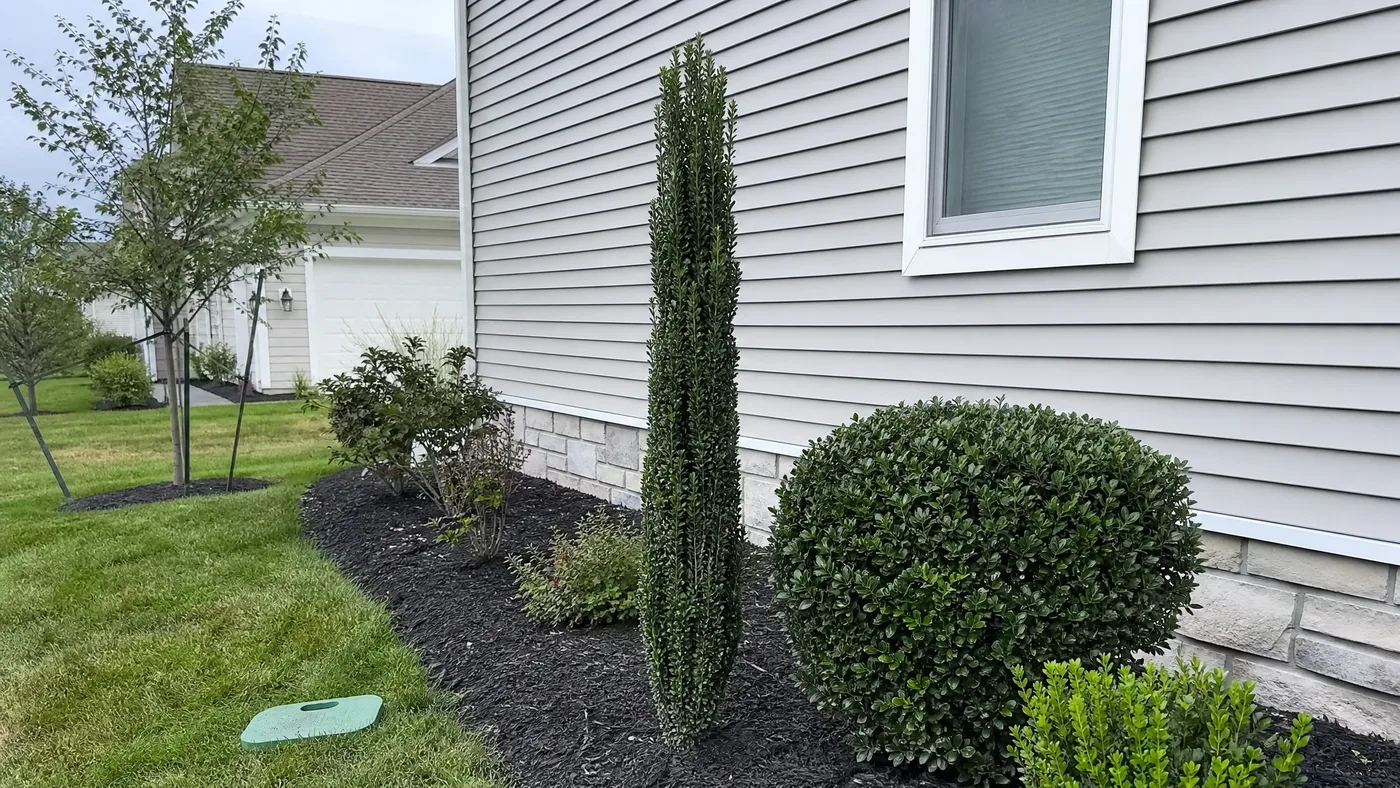
Sky Pencil Japanese Holly Varieties: How It Compares to Other Ilex
Sky Pencil is the best choice among Japanese hollies when you need a tall, very narrow evergreen. Most other Ilex crenata cultivars are wider, shorter or harder to find. At 1–3 feet wide and slow growing, it gives you a green vertical line where a round shrub would crowd a walkway.
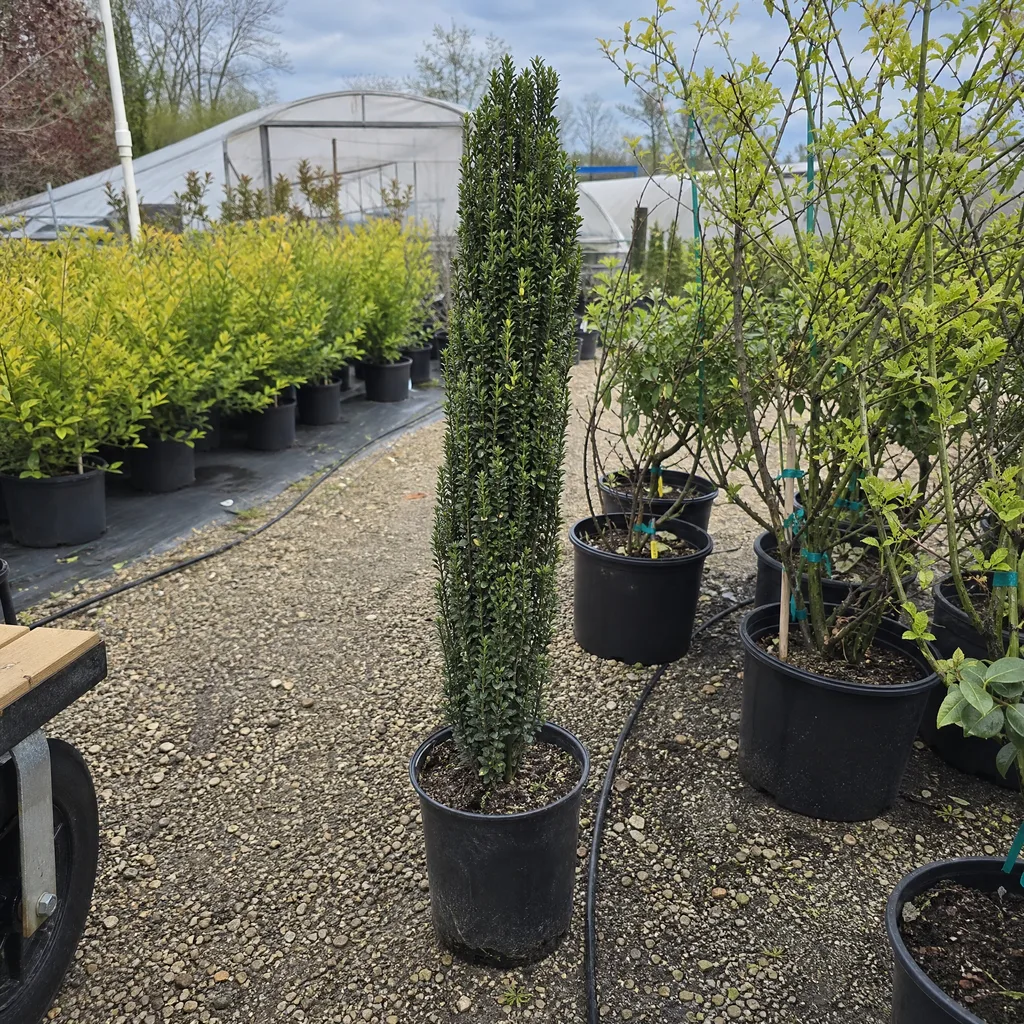
Pick the wrong cultivar and you replant in a few years, because a Helleri that spreads 3–4 feet won't fit the gap you measured for Sky Pencil. This guide covers everything you need to know about telling these hollies apart, from mature size and growth rate to hardiness zones and the job each one does best.
Choose well and you get a tidy evergreen column that looks the same in January as it does in July.
Choose Sky Pencil or Another Ilex: The Quick Decision
Match your site to one of the five jobs below, then plant the cultivar named in the winner line. If you are unsure, plant Sky Pencil. One of the most common questions we get is whether Sky Pencil and Helleri are interchangeable. They aren't, because Helleri is 3–4 feet wide and fills the space a Sky Pencil is meant to leave open.
Best for Tall, Narrow Screens and Accents
Winner: Sky Pencil
If you need a plant that stands 6 feet or taller and takes minimal horizontal space, Sky Pencil is the practical choice. Its combination of height, narrowness, and availability makes it the go-to for most of our customers. Learn more about caring for Sky Pencil through the growing season to get the most from your investment.
Best for Foundation Plantings and Compact Spaces
Winner: Compacta
Compacta's smaller final size makes it a better match for traditional foundation plantings flanking small porches or narrow doorways, where a Sky Pencil topping 6 feet would overwhelm the space. Hardy in zones 5–8.
Best for Formal Hedges and Borders
Winner: Helleri
If you're planting multiple shrubs in a row for a formal hedge, Helleri's bushier branching and moderate size create a more cohesive hedge line than Sky Pencil's narrow form.
Best for Contemporary or Boutique Landscapes
Winner: Soft Touch
Soft Touch's finer foliage suits modern and minimalist gardens where texture variety matters. It's a low, mounded holly that reaches only about 2–3 feet tall and 2–3 feet wide, with moderate growth, so it works as a rounded accent rather than a columnar form. It's worth the extra sourcing effort if foliage softness is a design priority.
Best for Maximum Drama and Extreme Narrowness
Winner: Sky Sentry or Straight and Narrow
For a one-of-a-kind focal point in a large landscape, these cultivars deliver unmatched vertical impact. Be prepared for longer wait times and specialty pricing.
Advice we don't follow: you will see sources telling you to buy the tallest cultivar available because height is the whole point of a columnar holly. We don't, because Sky Sentry and Straight and Narrow are special-order, cost more, and take a decade or more to reach full height. Plant Sky Pencil now and you get the same narrow shape years sooner.
What Sets Sky Pencil Apart From Other Ilex
Sky Pencil is a cultivar of Ilex crenata, the Japanese holly species native to Japan, Korea, China, and Taiwan. Within that species, nurseries offer several upright selections, each bred or selected for specific qualities. Sky Pencil is among the most narrow and tallest of these columnar forms, which is precisely why landscapers reach for it when space is tight or height is the priority.
Other Ilex crenata cultivars in commercial production take different approaches to the columnar form. Some prioritize extreme compactness. Others offer moderate height with dense branching. A few remain relatively obscure or region-specific. Knowing these distinctions helps you avoid buying the wrong plant and replanting later.
The species itself is a much wider shrub. Ilex crenata spreads 5–8 feet wide, while Sky Pencil stays 1–3 feet, so don't judge it by the rounded Japanese hollies in older foundation beds. Measure your planting strip before you shop.
Comparison Table: Sky Pencil vs. Other Ilex Crenata Cultivars
The table below puts the five cultivars side by side so you can compare size, growth rate and hardiness before you read the profiles.
| Cultivar | Mature Height | Mature Width | Growth Rate | USDA Zones | Best For |
|---|---|---|---|---|---|
| Sky Pencil | 4-10 ft | 1-3 ft | Slow | 5-8 | Tall narrow screens, entryway accents |
| Compacta | 6-8 ft | 6-10 ft | Slow | 6-8 | Foundation plantings, shorter hedges |
| Helleri | 4-5 ft | 3-4 ft | Slow | 6-8 | Hedge borders, mid-sized accents |
| Soft Touch | 2-3 ft | 2-3 ft | Moderate | 6-8 | Softer foliage preference, moderate height |
| Sky Sentry / Straight and Narrow | 8-12 ft | 1-2 ft | Slow | 6-8 | Maximum height in narrow footprint |
Breaking Down the Ilex Crenata Cultivars in Detail
Each profile below gives size, best use and trade-offs. Start with the cultivar that matches your site, then check the pros and cons before you buy.
Sky Pencil: The Workhorse Columnar
Sky Pencil is the most widely available cultivar and for good reason. Its columnar habit is naturally narrow without being extreme. Most plants reach 6–8 feet tall, with listings running up to 10 feet, and they stay only 1–3 feet wide.
Growth is slow, so plan on a gradual climb. By year five it reads as a clear vertical accent, and you don't have a giant plant to manage after two seasons. In our rows, it adds height steadily and never gets away from you.
The foliage consists of densely packed small oval leaves, glossy dark green year-round, and it can bronze in exposed, cold sites. It does well in sun to part shade, so site it by the space you have. Expect trouble in the hottest, most humid parts of zones 8 and 9. It's ideal for flanking entryways, defining narrow spaces, or creating a living screen where width is at a premium.
Pros: Excellent balance of height and narrowness, reliable growth habit, widely available, adaptable to sun or part shade, mildly deer resistant.
Cons: Can splay open in heavy snow or low light, needs consistent moisture, bronzes in exposed cold sites.
Compacta: Shorter, Bushier Footprint
If Sky Pencil is the tall accent, Compacta is the larger, rounded alternative. It typically reaches 6-8 feet tall and 6-10 feet wide, making it a better fit for broad foundation plantings and informal hedges. The growth is just as slow, but because the mature size is smaller, the plant reaches its full form faster in most landscapes.
Compacta works well in front of taller shrubs or as a standalone accent where you want a rounded, spreading form without dominating the space. It performs in zones 5-8, as Sky Pencil does.
Pros: Smaller mature footprint, faster to reach full size relative to height, good for tight foundation spaces.
Cons: Less dramatic vertical impact than Sky Pencil, may look too broad for narrow screens, wider than Sky Pencil for the same height.
Helleri: The Hedging Cultivar
Helleri is a time-tested variety, sometimes labeled the dwarf Japanese holly, that reaches 4-5 feet tall and 3-4 feet wide. It's used more often for formal hedging than as a solitary accent because of its fuller, bushier branching pattern. The growth rate remains slow, typical of the species.
If you're planning a low formal hedge or want multiple plants in a row, Helleri may be more practical than Sky Pencil. Its branching fills in sideways without aggressive shearing.
Pros: Naturally hedge-friendly branching, widely established, reliable in zones 6-8.
Cons: Too wide for single-accent use in tight spaces, less vertical drama than Sky Pencil, less commonly available in recent years than Sky Pencil.
Soft Touch: A Cultivar for Foliage Texture
Soft Touch is a more recent introduction marketed for slightly softer, finer foliage texture compared to Sky Pencil and other cultivars. It is a low, mounded holly that reaches only about 2-3 feet tall and 2-3 feet wide, with moderate growth. Zones 6-8 remain the reliable range.
Choose this cultivar if you want a dense, mounded, rounded shrub only 2-3 ft tall and wide with a softer look. It is harder to find in mainstream nurseries than Sky Pencil, so ask your nursery well ahead of planting.
Pros: Finer foliage, moderate height option, good for contemporary landscapes.
Cons: Harder to source, less commercial availability, growth rate documentation is less extensive than Sky Pencil.
Sky Sentry and Straight and Narrow: Maximum Height
Sky Sentry and Straight and Narrow are sports (natural mutations) of Sky Pencil and similar cultivars selected for even greater height, reaching 8-12 feet while maintaining 1-2 feet width. They're rarer in the commercial trade and often special-order items. Will Fleming holly gives a similar column but is a different species.
These are for landscapers who need a tall, narrow accent and are willing to wait a decade or more for full height. If you can't wait that long, other narrow evergreens can fill the space sooner. They perform in zones 6-8.
Pros: Maximized height in extremely narrow footprint, distinctive tall sculptural form.
Cons: Difficult to source, slow to mature, premium pricing, extremely specialty use case.
Sky Pencil's Real Standout Advantages
Three things keep Sky Pencil at the top of the commercial landscape market:
1. Width-to-Height Ratio
Sky Pencil packs 6 feet or more of height into just 1–3 feet of width. That efficiency is hard to beat. Other cultivars either give up height or demand more horizontal space. For narrow hedges, entryway flanking, or screening where property lines don't allow wider plants, Sky Pencil's ratio is genuinely irreplaceable.
2. Availability and Proven Track Record
Sky Pencil has been in cultivation long enough and is popular enough that almost every mid-to-large nursery stocks it. You can find well-established trees in #1, #3, or larger containers. The long commercial history also means years of feedback from real gardens, not just greenhouse trials. Growers understand its quirks, hardiness, and performance.
3. Balanced Performance Across Its Range
Sky Pencil doesn't push the limits of hardiness or require coddling in exposed sites. NC State lists it for zones 5a through 8b, while Oregon State is more cautious at zone 6, so shelter it from wind in zone 5. Foliage can bronze in extreme cold, but the plant survives. Its moisture needs are moderate and standard for well-drained soil, so there are fewer surprises than with newer or more finicky cultivars.
For proper planting and site selection, the details matter more than the cultivar itself. All Ilex crenata cultivars want moist, well-drained soil that is acid or neutral, and chlorosis can develop in alkaline soil on any of them. Water new plants deeply and keep the soil evenly moist through the first season.
Quick Reference: Choosing Your Ilex Cultivar
Use this table as a last check before you place your order. Find your landscape need in the left column and buy the cultivar beside it.
| Landscape Need | Recommended Cultivar | Why |
|---|---|---|
| Tall narrow screen (6+ ft, tight space) | Sky Pencil | Best height-to-width balance and widely available |
| Compact foundation accent (under 5 ft) | Compacta | Smaller final size, less overwhelming near structures |
| Formal hedge or border (multiple plants) | Helleri | Bushier branching, forms cohesive hedge line |
| Modern/textured landscape design | Soft Touch | Finer foliage, design-forward aesthetic |
| Maximum height and narrowness (statement piece) | Sky Sentry or Straight and Narrow | 8-12 ft with 1-2 ft width, specialty impact |
| Reliable fallback (when unsure) | Sky Pencil | Proven performance, easy to source, balanced habit |
Sky Pencil Is the Default Ilex for Narrow Spaces
Plant Sky Pencil when you need height in a strip only a foot or two wide. Choose Compacta for low foundation beds, Helleri for a formal hedge, and Soft Touch when foliage texture matters most. Save Sky Sentry and Straight and Narrow for a rare statement piece, and for most yards stick with the cultivar that is easy to find and proven.
Sky Pencil Japanese Holly
Nursery-grown Sky Pencil Japanese Holly in sizes from 1-2 ft. #1 Container, shipped to your door.
From $80.55
Shop Now →Before a plant leaves us, we check every Sky Pencil for a straight central stem, even dark green foliage down to the base and a firm, well-filled root ball. We are a small business with our own farms, and we grow and sell top-quality shrubs we would be glad to plant ourselves.